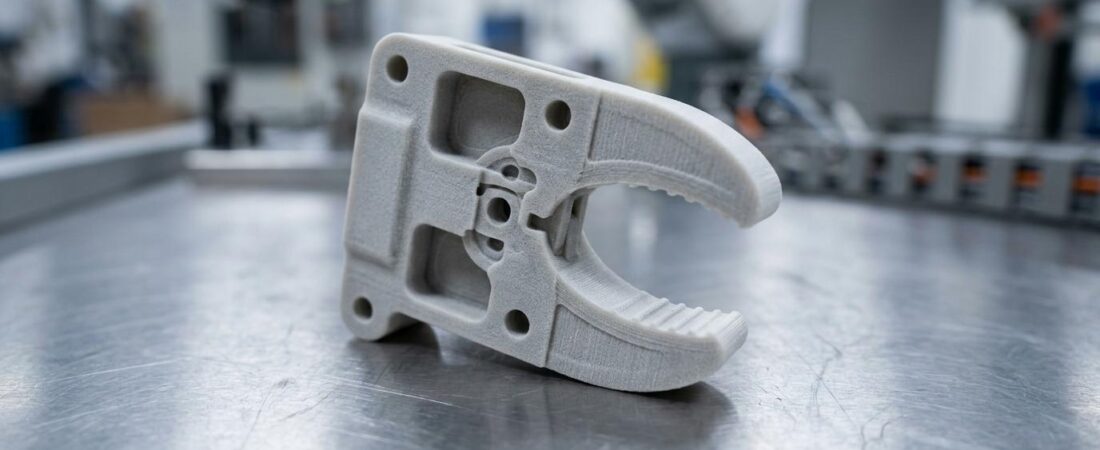
PA12 has earned a strong place in industrial additive manufacturing because it solves a very practical problem: many printed plastics are fine for visual models, but far fewer are dependable when a part has to work, keep working, and hold up in a real operating environment.
That is where PA12 stands out. Also known as Nylon 12, it offers a rare balance of toughness, dimensional stability, chemical resistance, and usable heat performance. For engineers, maintenance teams, and procurement specialists, that balance matters far more than a headline strength figure on a datasheet.
Why PA12 3D printing suits industrial parts
PA12 is a semi-crystalline engineering thermoplastic that performs well when parts face repeated use, vibration, impact, and contact with moisture or chemicals. Printed components made from PA12 are usually tough rather than brittle, which makes them better suited to functional service than many common desktop printing materials.
A second advantage is consistency in real conditions. Compared with many other nylons, PA12 absorbs less moisture. That means a printed part is less likely to swell, soften, or drift dimensionally when it moves from a dry workshop to a humid plant, mine site, or outdoor installation.
For industrial users, that adds up to a material that is easier to trust for more than prototypes.
PA12 is often chosen when a part needs to combine:
- impact resistance
- fatigue durability
- low moisture uptake
- chemical resistance
- moderate heat tolerance
- lightweight construction
Those traits make PA12 useful for production parts, fixtures, jigs, covers, enclosures, ducting, clips, brackets, and replacement components where fast delivery has real operational value.
PA12 material properties that matter in service
The appeal of PA12 is not only that it prints well. It is that the finished part behaves like an engineering component. Typical PA12 parts produced through industrial powder-bed fusion processes can deliver tensile strength around the high-40 MPa range, moderate stiffness, and enough elongation to absorb shock without cracking too easily.
That mix of stiffness and ductility is a big reason why PA12 performs well in snap features, housings, guards, and mechanically loaded brackets. A rigid but brittle material may look fine on day one and fail after a few impacts. PA12 is more forgiving.
Heat performance also lifts it above entry-level printing materials. While it is not a replacement for high-temperature polymers in extreme thermal zones, it can handle the moderate heat seen in many industrial settings. Long-term service around 80°C is commonly cited, with short-term exposure higher than that depending on geometry and load.
Chemical resistance is another strength. PA12 typically handles oils, greases, fuels, and many cleaning agents better than materials like PLA and ABS. In workshops, processing plants, transport equipment, and field service applications, that can make the difference between a part that lasts and one that degrades early.
PA12 3D printing processes for functional manufacturing
In industrial production, PA12 is commonly processed with powder-bed fusion technologies, especially SLS and MJF. These systems build parts layer by layer inside a powder bed, which supports the geometry during printing. Because the surrounding powder acts as support, complex shapes can often be produced without the support structures needed in other printing methods.
That brings real design freedom. Internal channels, lattices, nested parts, organic geometries, and consolidated assemblies are all much more realistic in PA12 powder-bed printing than in machining or conventional moulding.
A typical industrial workflow usually includes several steps before a part is approved for use:
- CAD review: wall thickness, feature strength, tolerance risk, build orientation
- Print preparation: packing parts efficiently within the build volume
- Powder recovery: removing and reclaiming unsintered material after the build
- Surface finishing: bead blasting, smoothing, dyeing, coating, or painting
- Inspection: visual checks and dimensional verification for critical features
The quality of this workflow matters just as much as the material itself. A capable manufacturing partner should not only print the file but also flag weak ribs, oversized flat areas, poor thread design, or tight tolerance zones before production begins.
PA12 post-processing options for industrial parts
As-printed PA12 usually has a matte, slightly textured surface. That is perfectly acceptable for many functional parts, especially tooling, fixtures, covers, and internal components. Yet many projects benefit from extra finishing.
Bead blasting is common and improves surface cleanliness. Dyeing adds durable colour. Vapour or chemical smoothing can reduce surface roughness and create a more refined look, which can be useful for consumer-facing parts, fluid-contact applications, or assemblies where a smoother finish assists cleaning.
Coatings may also be used when a part needs extra surface protection, better wear behaviour, or a specific visual finish.
PA12 design considerations for better 3D printed results
Good PA12 parts start with good design choices. Even though powder-bed fusion allows complex geometry, industrial design discipline still matters. A part should be designed for load paths, local stiffness, tolerance stack-up, assembly method, and the realities of post-processing.
Wall thickness is one of the first checkpoints. Very thin walls may print, but they may not survive handling or service. Thick solid sections can add weight and cost without delivering much value. In many cases, ribs, hollow forms, and controlled wall sections give better results than oversized solid bodies.
Tolerance planning is just as important. PA12 3D printing is accurate enough for a wide range of industrial uses, but it is not a direct substitute for precision CNC machining in every feature. Press fits, bearing seats, sealing surfaces, and fine threads may need secondary machining or design offsets. That is not a drawback so much as good engineering practice.
A few design habits usually pay off quickly:
- Consolidate parts: replace multi-piece assemblies where possible
- Use radii: reduce stress concentrations at corners
- Plan interfaces: allow clearance for mating parts and fasteners
- Choose finish early: surface treatment can affect fit and appearance
One of the strongest reasons to use PA12 is that designers can simplify assemblies. Multiple brackets, spacers, cable guides, and covers can often become one printed part. That reduces hardware count, lowers assembly time, and cuts the number of failure points.
PA12 applications across Australian industry
PA12 is widely used in sectors where downtime, weight, and supply-chain delays all carry a cost. In Australia, that includes mining, transport, manufacturing, agriculture, defence support, medical technology, and robotics, along with more established use in automotive and aerospace programs.
In maintenance and operations, PA12 is valuable for replacement parts that are hard to source or no longer supported by an OEM. A legacy cover, guide, mount, sensor housing, or protective shroud can often be recreated quickly from CAD or reverse-engineered geometry. That can keep equipment running without the long wait tied to conventional spares.
In manufacturing, PA12 is frequently chosen for end-of-arm tooling, custom grippers, drill guides, assembly fixtures, and ergonomic handling aids. The low weight helps operators and robots alike. The toughness helps those tools survive repetitive use.
Common PA12 applications include:
- brackets and mounts
- cable guides
- housings and enclosures
- fluid and air ducting
- jigs and fixtures
- replacement wear parts
A useful example is robotic end-of-arm tooling. A metal EOAT setup may be heavier than necessary and harder to revise. A PA12 version can cut mass, combine several pieces into one, and speed up iteration when the line changes.
PA12 mechanical performance compared with other 3D printing materials
A lot of materials look viable when viewed only through tensile strength. The real question is broader: how does the part behave after impact, over repeated cycles, in moisture, and around oils or cleaning fluids?
PA12 performs well because its property set is balanced rather than extreme in only one direction.
| Material | Tensile Strength | Elongation at Break | Moisture Behaviour | Heat Resistance | Typical Fit |
|---|---|---|---|---|---|
| PA12 | ~45 to 50 MPa | ~15 to 20% | Low uptake for a nylon | Good for moderate industrial heat | Functional parts, tooling, housings |
| PA11 | ~50 MPa | Higher than PA12 | Good | Good | Tougher, more ductile nylon parts |
| ABS | ~35 to 40 MPa | ~10 to 15% | Moderate | Moderate | General-purpose enclosures |
| PLA | ~50 to 60 MPa | ~3 to 6% | Sensitive in service | Poor in heat | Visual models, light-duty parts |
| TPU | Much lower | Very high | Good | Moderate | Flexible components |
PLA can look strong on paper, yet it is far more brittle and far less heat tolerant. ABS is familiar and useful, though it usually falls behind PA12 in chemical resistance and long-term durability. TPU fills a different role altogether, trading stiffness for flexibility.
For industrial teams, PA12 often lands in the sweet spot. It is strong enough for many structural plastic parts, tough enough for repeated handling, and stable enough for demanding environments.
PA12 3D printing versus machining and injection moulding
PA12 3D printing is not meant to replace every conventional process. It is best viewed as a highly effective manufacturing option when speed, geometry, and volume profile make it the smarter route.
For low to medium volumes, additive manufacturing usually avoids the tooling cost tied to injection moulding. A design can move from CAD to finished parts in days rather than waiting weeks or months for tooling. That makes PA12 attractive for bridge production, spare parts, pilot runs, custom equipment, and ongoing low-volume demand.
Compared with CNC machining, PA12 printing cuts away much less material and allows geometry that would be expensive or impossible to machine efficiently. Internal channels, trapped features, lattice zones, and consolidated assemblies are all strong examples.
The trade-off is that additive manufacturing will not always match the surface finish or ultra-tight tolerances of precision machining or high-end moulding straight off the machine. Where needed, secondary finishing and machining can close that gap for critical features.
When PA12 is the right material for industrial manufacturing
PA12 is a strong candidate when the part needs to be functional, durable, and available quickly. It fits especially well where geometry is complex, demand is variable, or redesign is likely.
It also makes sense when local support, engineering input, and rapid quoting are part of the decision. For teams working on production tooling, replacement parts, or functional prototypes, a supplier with industrial-grade PA12 capability can help shorten lead times without forcing compromises on material quality.
That is why PA12 remains one of the most dependable materials in industrial additive manufacturing. It gives engineers room to design better parts, gives procurement teams a practical path for low-volume supply, and gives maintenance teams a faster way to get equipment back into service.