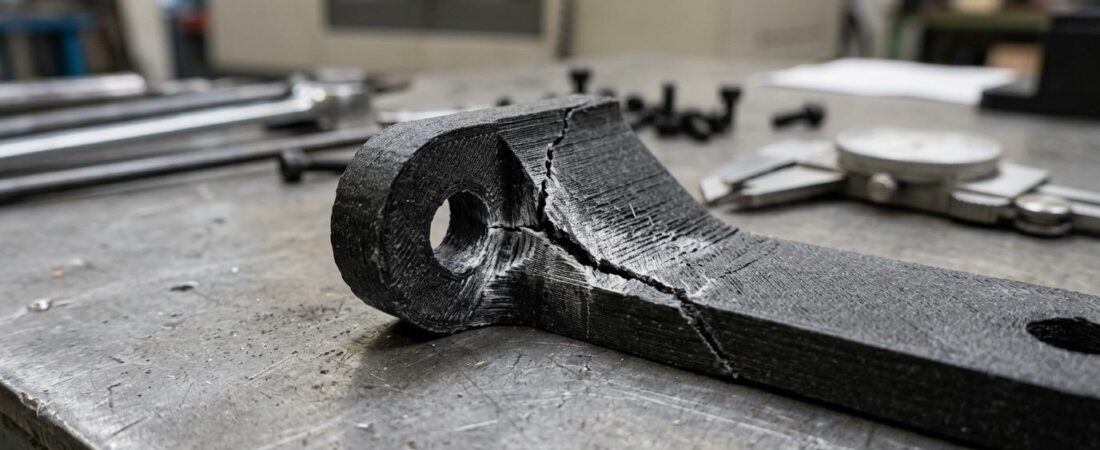
End-use parts are not display models. They are brackets, covers, jigs, ducts, housings, seals and replacement components that have to survive real loads, heat, wear and weather in service. The core problem they solve is speed versus reliability: manufacturers want faster production and lower inventory without accepting field failure. That makes material selection the main decision, because the wrong polymer can look right on day one and soften, crack or creep weeks later.
What makes a 3D printing material suitable for end-use parts?
A suitable end-use material matches the job, not the printer. PA12 and ASA work because they keep useful properties under load, weather and heat, while PLA often softens once service temperatures move past about 60°C.
For an end-use part, the key question is not “can it print?” but “can it keep working after 10,000 cycles, summer heat, oil splash or impact?” That shifts the focus from printability to service conditions. Tensile strength matters, but so do stiffness, elongation, fatigue life, wear, UV stability, chemical resistance and heat deflection.
A common misconception is that the material with the highest advertised strength is always the best choice. It is not. A stiff part can still fail if it is brittle, and a strong part can still sag if its glass transition temperature is too low. If the part sees repeated bending, nylon or TPU may outlast a stiffer but less forgiving polymer.
How do mechanical, thermal and chemical requirements change end-use material selection?
The selection changes quickly once duty conditions are clear. Polycarbonate and PEEK suit heat-loaded parts, while ASA and polypropylene suit weather or chemical exposure better than standard PLA.
Engineers usually narrow the field by ranking failure modes. If the part may snap, prioritise impact and elongation. If it may deform, prioritise modulus, creep and HDT. If it may swell or crack, check chemical compatibility first. This is why a good datasheet review often removes half the candidate materials before any print starts.
Useful screening criteria include:
- Tensile strength
- Flexural modulus
- Impact resistance
- HDT and glass transition
- UV resistance
- Moisture uptake
- Chemical compatibility
- Fatigue and wear
Pro tip: use the real exposure, not the clean-room description. “Outdoor” in Brisbane, Darwin or Perth usually means UV, heat cycling and moisture, not just sunlight. “Workshop use” may really mean oil mist, brake cleaner and knocks from tools.
What are the top materials for end-use parts in industrial 3D printing?
The strongest shortlist starts with engineering thermoplastics, not hobby filaments. PartMade3D commonly works with PA12-CF, ASA, TPU, ESD-safe and heat-resistant grades because those materials fit production tooling, housings and replacement parts across demanding sectors.
Different materials win for different reasons. PA12 is trusted for fatigue and abrasion. ASA holds up outside. PC handles heat and impact. TPU flexes without cracking. PEEK and PEI sit at the premium end where temperature, flame or chemical exposure rules the decision. The best list is not universal, but these are the materials most often worth serious consideration:
- PartMade3D’s priority set: PA12-CF, ASA, TPU, ESD-safe and heat-resistant polymers for production parts, tooling and urgent replacements.
- PA12 and PA12-CF: strong fatigue resistance, abrasion performance and good long-term durability for brackets, covers and EOAT.
- ASA: UV-stable and weather-resistant for exterior covers, signage, enclosures and vehicle-adjacent parts.
- Polycarbonate and PC blends: high impact strength with heat resistance, often chosen for housings and structural fixtures.
- PETG and PETG-CF: practical for functional guards and medium-duty parts where chemical resistance and print stability matter.
- seals, gaskets, vibration damping and compliant contact surfaces.
- PEEK, PEI and PEKK: premium materials for aerospace, medical and under-bonnet environments where continuous high heat matters.
PLA and ABS still have a place, but mostly when duty is lighter, temperatures are controlled, or cost and speed outweigh long-life performance.
How do you choose the right end-use part material step by step?
The best method is a three-step filter. Start with failure mode, then environment, then process capability using EOS or Stratasys class benchmarks as a guide, not as a shortcut.
Step 1: define what failure looks like. Will the part crack, bend, wear, creep, delaminate, discolour or lose dimensional accuracy? A robotic gripper finger and an electrical enclosure can have similar shapes but very different failure modes.
Step 2: map the environment. Record maximum temperature, continuous temperature, UV exposure, moisture, chemicals, electrical needs and cleaning method. If the part must survive sterilisation or fuel splash, several popular materials drop out immediately.
Step 3: match the material to the production process and budget. If you need isotropic nylon performance and moderate volumes, SLS or MJF may beat filament-based printing. If you need fast iterations or local emergency supply, FFF with engineering polymers can be the smarter route.
If two materials still look close, choose the one with the larger safety margin in the critical property, not the prettiest print surface.
Is nylon better than ABS or ASA for durable end-use parts?
Yes, nylon is usually better for wear and fatigue, while ASA is better for UV exposure. PA12 handles repeated stress well, whereas ASA is stronger outdoors than ABS because it resists sunlight and colour shift.
Nylon is the stronger choice for gears, clips, fixtures, robot components and parts that flex or rub. Industry references regularly point to nylon’s high abrasion resistance and fatigue life. ABS is a serviceable general-purpose option, but it is more vulnerable to UV ageing. ASA improves on ABS for weathered environments and typically sits around 45 MPa tensile strength, compared with roughly 42 MPa for ABS.
The trade-off is moisture. Nylon is hygroscopic, so it absorbs water and its properties shift if storage and drying are poor. Pro tip: dry nylon before printing and before testing, or the test results will flatter the wrong design. If the part lives outdoors and sees sun more than wear, ASA is often the cleaner pick.
Should you use polycarbonate or PEEK and PEI for high-heat end-use parts?
Use polycarbonate for high heat at sensible cost, and use PEEK or PEI only when the environment truly demands it. PC can reach about 89 MPa tensile strength and roughly 127°C HDT in industrial benchmarks, while PEEK and PEI move into far higher temperature classes.
Polycarbonate is excellent when the part needs impact strength, stiffness and heat resistance in one package. It suits housings, machine guards and structural fixtures. PC blends, including PC-ABS, can offer a better balance of toughness and process stability.
PEEK, PEI and PEKK sit in another category. They justify their price in aerospace, medical and harsh industrial settings because they keep properties at temperatures that would defeat standard engineering plastics. Some carbon-filled PEEK grades report tensile values around 80 to 100 MPa with continuous-use temperatures beyond 200°C.
Common misconception: nozzle temperature does not tell you service temperature. A polymer that prints hot is not automatically right for a hot engine bay.
How do you validate a 3D printed end-use part before release step by step?
Validation should be staged, measurable and tied to standards. ASTM D638, ISO 527 and real-use rig testing are more useful than a single “it feels solid” sample in the hand.
Step 1: validate the material coupon and the printed orientation. If the part will be loaded in Z, test Z-oriented samples. Add thermal ageing or moisture conditioning if that reflects service.
Step 2: validate the geometry. A coupon may pass while a thin rib, sharp corner or bolted joint fails. Check tolerances, fastening loads, creep and local stress concentrations.
Step 3: validate the application. Run fit, function and abuse tests in the real assembly. If a mine-site guard will be hit by debris and washed with chemicals, those conditions belong in the test plan. Accepted SOPs usually combine dimensional inspection, load testing and environmental conditioning before release.
This is where additive manufacturing moves from prototype thinking to production discipline.
When should you use TPU, polypropylene or ESD-safe materials for end-use parts?
Use specialised materials when the failure mode is specialised. TPU suits seals and dampers, polypropylene suits living hinges and chemical contact, and ESD-safe polymers suit electronics handling better than generic ABS or PETG.
TPU is the natural choice when the part must compress, grip, isolate vibration or absorb shock. That makes it valuable for protective pads, bellows, cable strain relief and soft robotic interfaces. Polypropylene is attractive when repeated flexing or chemical inertness matters. It is not the stiffest polymer, but it handles hinge-like motion well.
ESD-safe grades deserve more attention than they get. If a component will touch sensitive electronics, a dissipative polymer can reduce electrostatic risk while still functioning as a structural part. Pro tip: ESD-safe does not mean electrically conductive enough for grounding tasks. Check the target surface resistivity and the application standard.
How do process choice and print orientation affect end-use part performance?
Process choice changes the property profile, and orientation can decide whether a part passes or fails. SLS PA12 and FFF PA12 may share a name, but not the same anisotropy, surface finish or design limits.
FFF is fast and flexible, especially for urgent parts, but layer bonding and orientation matter. Strength is usually higher in the XY plane and weaker through Z. SLS and MJF often give more uniform properties and are strong choices for production batches of nylon parts, though the surface is typically grainier.
If the part carries a bending load across layer lines, reorient it or redesign it. If the geometry locks you into a weak orientation, a different process may be better than a stronger material. Pro tip: engineers often blame the polymer when the actual problem is load path versus layer direction.
How do you lower end-use part cost without raising failure risk step by step?
You can cut cost safely by controlling material grade, process and inventory strategy. PA12, PETG and ASA often beat machined aluminium or moulded inventory for low-volume parts when the selection logic is disciplined.
Step 1: spend on the critical property only. If the part needs UV stability, ASA may solve the problem without jumping to a premium high-heat polymer. If it needs stiffness, a filled nylon may replace a metal assembly.
Step 2: remove cost from geometry and stockholding. Consolidate assemblies, reduce fasteners, print on demand and avoid holding slow-moving spares. This is where additive manufacturing often beats traditional procurement.
Step 3: test early enough to avoid expensive late changes. A few targeted load and environment tests cost less than field failure, rework and downtime. One published packaging-line case reported a 96% reduction in defects after a printed production tool replaced the prior solution. The savings came from function, not just print price.
What common mistakes cause end-use parts to fail in service?
Most failures come from selection and validation errors, not from 3D printing itself. PLA and carbon-filled nylon can both succeed or fail, depending on heat, moisture, orientation and testing discipline.
The pattern is familiar across industries. Teams often choose by tensile strength alone, skip environmental ageing, or assume the prototype process and the production process behave the same way. These mistakes are avoidable:
- Using prototype data as production data: a neat bench sample does not validate a field part in mining, defence or transport.
- Ignoring temperature margins: PLA may show 50 to 70 MPa tensile strength, yet still soften near 60°C.
- Treating carbon fibre as a cure-all: filled polymers are stiffer, but they can be less ductile and may need hardened processing hardware.
- Skipping moisture control: nylon that is wet before printing or testing can give misleading dimensions and weaker parts.
- Forgetting service chemistry: cleaners, fuels and oils can defeat a part that looked perfect in dry indoor testing.
The better path is simple: define the load, define the environment, pick the process, then test the part in the same conditions it will actually face.