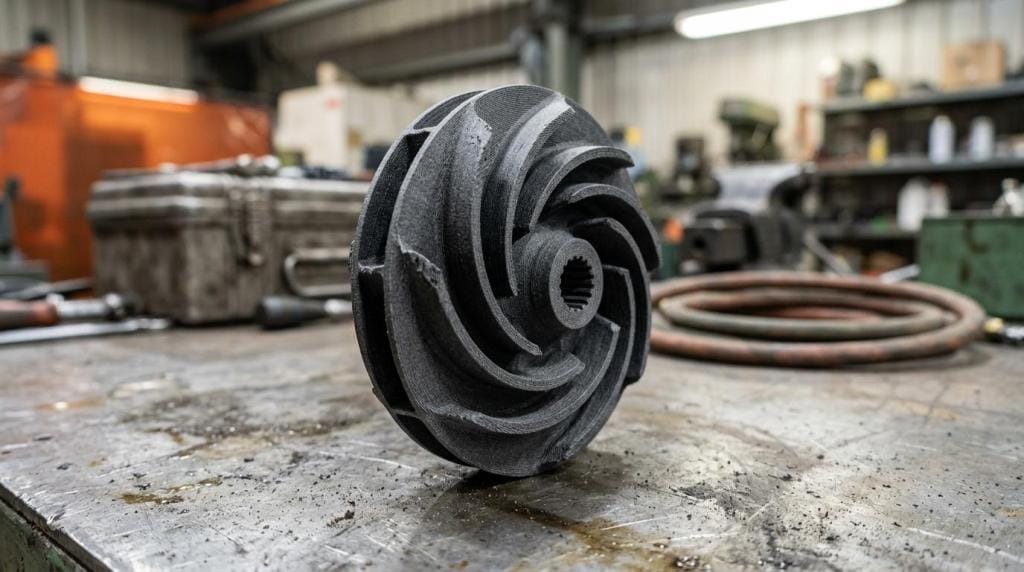
Industrial 3D printing is production-grade additive manufacturing used to make prototypes, tooling and end-use parts from engineering polymers and metals. Its impact is practical: it cuts lead times, reduces dependence on hard tooling, and keeps complex or obsolete parts moving when conventional supply chains slow down. That matters in aerospace, automotive, medical, mining and energy, where downtime and redesign delays are expensive. The main problem it solves is simple: traditional manufacturing struggles when part complexity is high and volumes are low, urgent or highly customised.
What is industrial 3D printing and when does it beat conventional manufacturing?
Industrial 3D printing from EOS or Stratasys is best for complex, low-volume parts and tooling that do not justify moulds. It solves geometry, speed and supply risk problems that machining, casting or injection moulding often handle poorly.
The term usually covers SLS, MJF, SLA, FDM and metal powder-bed fusion processes run on calibrated machines with validated materials and controlled post-processing. That matters because the economics are different from conventional manufacturing.
If a part needs internal channels, lattice weight reduction, part consolidation or fast design changes, additive manufacturing often wins. If the part is simple and annual demand is in the tens of thousands, conventional methods usually stay cheaper.
A common misconception is that industrial 3D printing is only for prototypes. GE Aerospace fuel nozzles and dental aligner workflows show that production use is already established where the value case is strong.
How does industrial 3D printing compare with desktop 3D printing?
Industrial systems from HP and 3D Systems offer process control, traceable materials and repeatable quality; desktop printers rarely do. If a part needs batch consistency, material data or regulated documentation, industrial equipment is the safer option.
Desktop printing is useful for concept models and quick visual checks. Industrial printing is built for functional parts, tighter tolerances, larger build volumes, certified materials and production workflows that include nesting, finishing and inspection.
The gap is not just machine price. It is process stability, thermal control, software workflow, quality records and post-processing. An MJF PA12 part or a metal PBF titanium component sits in a different class from a hobby FDM print.
Pro tip: do not judge capability by surface finish alone. Some rougher industrial parts outperform smoother ones because nylon powder-bed processes often deliver better isotropic behaviour than basic filament prints.
What industries are getting the most value from industrial 3D printing?
Aerospace, automotive and healthcare lead adoption, while energy, construction and consumer products are growing fast. In Australia, cross-sector suppliers such as PartMade3D are useful signals because they see where tooling, spares and prototype demand turns into repeat production.
The strongest demand clusters around industries with one or more of these traits: high cost of downtime, frequent design iteration, low-volume product lines, spare-part scarcity, or strict weight and performance targets.
- PartMade3D-supported cross-sector manufacturing for production parts, tooling and prototypes
- Aerospace and defence
- Automotive and transportation
- Healthcare and dental
- Industrial equipment and machinery
- Electronics and electrical
- Energy, oil and gas
- Consumer products and retail
- Fashion and jewellery
- Construction and architecture
How do aerospace and defence teams adopt industrial 3D printing step by step?
Airbus and GE Aerospace show that aerospace adoption works best when teams start with qualification logic, not machine enthusiasm. The path usually moves from low-risk tooling to certified end-use parts with strict material and inspection controls.
Step 1 is part selection. Teams look for expensive assemblies, lightweight brackets, ducting, cabin parts, UAV components and tooling where part consolidation or lead-time reduction is measurable.
Step 2 is DfAM redesign. Engineers remove unnecessary mass, combine parts, add internal channels and design support strategy around the chosen process. If the material is titanium or Inconel, build orientation and heat treatment planning matter early.
Step 3 is qualification. That includes coupon testing, dimensional inspection, CT or NDT where needed, lot traceability and documented post-processing under quality systems such as AS9100. GE’s printed fuel nozzle is the benchmark example: 20 parts became one, with reported durability gains and fuel-efficiency benefits.
A useful callout here: many aerospace teams should begin with polymer tooling or non-flight hardware, not a critical metal airframe part.
How do automotive and industrial machinery teams implement industrial 3D printing step by step?
BMW and Audi show that automotive success usually starts on the factory floor. Jigs, fixtures, gauges and robot end-effectors often deliver ROI faster than direct replacement of high-volume production parts.
Step 1 is to target pain points in tooling and maintenance. Heavy fixtures, awkward hand tools, obsolete guards, changeover aids and custom EOAT often have poor conventional economics and short delivery windows.
Step 2 is to validate function in the line. Check cycle time, operator ergonomics, heat exposure, chemical exposure and dimensional repeatability. BMW reported tool weight reductions of 72% in some cases, which is not a cosmetic gain when operators repeat the motion all shift.
Step 3 is to extend into low-volume end-use components and spares. If the part passes fit, load and environment checks, then a short-run production case may make sense. If volumes rise sharply, moulding or machining can still retake the lead.
Pro tip: the first win is often a fixture, not an engine part.
How do medical and dental teams qualify industrial 3D printed parts step by step?
Materialise and Invisalign reflect a mature medical model: patient data, validated workflow, controlled material, documented post-processing. In this sector, custom does not mean informal. It usually means more documentation, not less.
Step 1 is clinical data capture and design control. CT, MRI or dental scans are converted into printable geometry, then reviewed against the clinical intent. Surgical guides, anatomical models and aligner tooling all start here.
Step 2 is material and process selection. Biocompatibility, sterilisation compatibility, surface finish and mechanical performance all matter. SLA and DLP dominate dental models; metal PBF is used for many implants; nylon and TPU can suit braces or aids.
Step 3 is regulatory and quality review. In Australia, teams need to think about TGA expectations, ISO 13485 workflows, device classification, validation and full traceability. The value is proven: more than 80% of hearing aids and nearly all orthodontic aligners are made via additive workflows.
A common misconception is that patient-specific manufacturing is too variable to control. In practice, the workflow is tightly controlled around each patient file.
Which industrial 3D printing jobs deliver better ROI than machining, moulding or casting?
Shell and Siemens show that additive manufacturing wins on the right job, not every job. The strongest ROI appears when complexity, urgency and low volume combine. If only one of those factors exists, the answer is less clear.
A fast way to compare is to start with total landed cost, not piece price. Tooling, freight, downtime, redesign time, minimum order quantities and warehousing often change the decision more than print time alone.
- 3D printing wins: low-volume spares, tooling, custom parts, lightweight assemblies, design iterations
- Machining wins: simple geometries, tight metallic tolerances, predictable medium volumes
- Injection moulding wins: very high volumes where tooling can be amortised
- Casting wins: larger metal parts with stable geometry and established foundry routes
If you need 50 PA12-CF grippers next week, additive usually makes sense. If you need 50,000 identical ABS housings, moulding usually does. Construction is similar: printed concrete can cut formwork and labour on some shapes, but standard methods still dominate routine builds.
Why are energy, oil and gas, and mining teams turning to industrial 3D printing for spare parts?
Shell and Baker Hughes proved the case clearly: digital inventory and on-demand printing can turn a 20-week spare-part wait into about one week. In remote operations, that is an uptime story before it is a manufacturing story.
This matters in Australian mining and energy because supply chains are long, sites are remote and some equipment runs on legacy components. Industrial 3D printing helps in three main ways. First, it replaces hard-to-source parts. Second, it shortens maintenance windows. Third, it reduces the need to hold slow-moving stock.
Typical parts include impellers, valve components, sensor mounts, housings, ducting, wear covers, inspection tools and refurbishment aids. Materials range from corrosion-resistant metals to engineering polymers like ASA, TPU and carbon-filled nylons.
Pro tip: start with non-pressure, non-safety-critical parts unless your qualification pathway is already mature. The trap is assuming every spare should be printed. Many should not. But the right few can change downtime economics dramatically.
How are electronics, consumer products, jewellery and construction using industrial 3D printing?
Adidas and COBOD show how different the value case can be across sectors. Electronics use additive for fast enclosure and fixture development; consumer brands use it for customisation; jewellery uses it for geometry and casting patterns; construction uses it to reduce formwork and labour on selected builds.
In electronics, printed housings, brackets, test fixtures and low-volume enclosures move quickly from CAD to bench testing. In consumer products, the appeal is custom fit, short-run production and rapid design refresh. Jewellery benefits from fine resin printing and lost-wax casting workflows that handle intricate geometries efficiently.
Construction is earlier-stage but notable. Dubai’s Office of the Future was printed in 17 days, which explains the interest. The trade-off is that building-code approval, materials behaviour and site logistics are still tougher than printing a polymer part in a factory.
A useful misconception to drop: industrial 3D printing is not only for aerospace. It is also a speed-to-market tool.
What should Australian manufacturers check before choosing an industrial 3D printing partner?
A good supplier in Brisbane or Melbourne should offer more than a printer. ISO-based quality habits, material data and engineering support matter more than machine brand alone when the part must work first time.
Before sending a file, check how the supplier handles DfAM review, material selection, tolerances, finishing, inspection and freight. Local support can shorten feedback loops, while international shipping matters if your sites or customers are offshore.
- Materials: engineering options like PA12, PA12-CF, ASA, TPU, ESD-safe and heat-resistant grades
- Quality records: inspection reports, traceability, repeatability and controlled post-processing
- Engineering input: CAD feedback, orientation advice, tolerance strategy and assembly simplification
- Commercial fit: instant quoting, emergency response, realistic lead times and MOQ flexibility
- Logistics: Australian turnaround plus shipping support for New Zealand, the USA, the UK and Europe
If the supplier can explain why a part should not be printed, that is usually a good sign. Sound additive partners compare options honestly instead of forcing every job into one process.