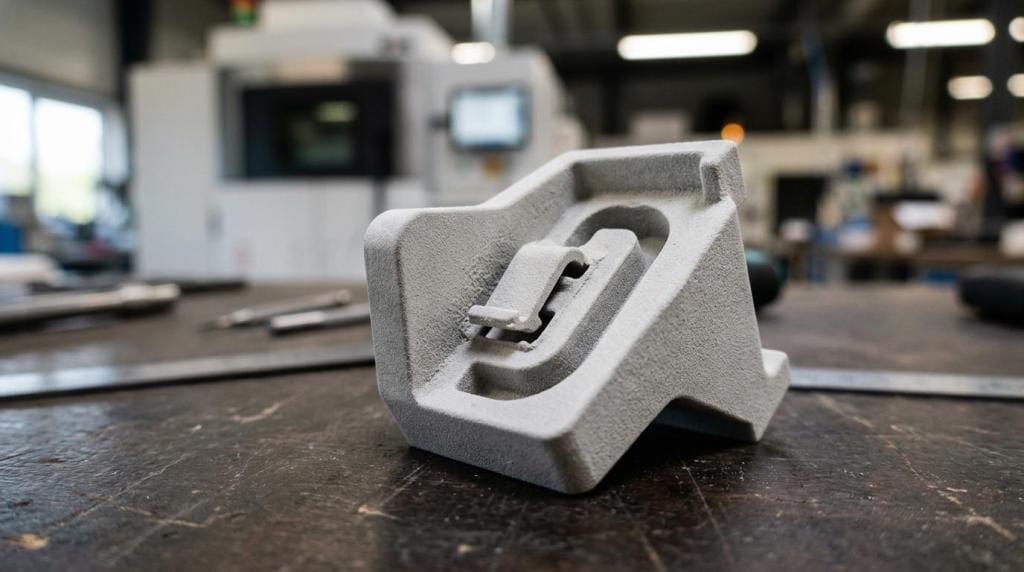
Selective laser sintering has moved well beyond prototype status. For many manufacturers, it now sits in a very practical space between one-off development work and full-scale injection moulding. That makes it especially useful when parts need to be functional, durable and ready for service, but volumes do not justify tooling or the design is still changing.
This is where SLS becomes commercially interesting. It can produce polymer parts with the kind of strength, thermal stability and design freedom that engineers expect from production components, while keeping lead times short and fixed costs low. For Australian teams working across maintenance, new product introduction, robotics, automotive, aerospace and mining, that combination is hard to ignore.
How selective laser sintering supports end-use part production
SLS is a powder bed fusion process. A laser selectively sinters thin layers of polymer powder, usually nylon-based materials, until a complete part is formed inside the powder bed. Because the surrounding powder supports the geometry during the build, there is no need for dedicated support structures.
That sounds like a technical detail, but it changes a lot. Internal channels, undercuts, lattices, snap fits and complex housings become much easier to manufacture. It also means less post-processing than support-heavy technologies and far fewer design compromises than many traditional methods.
For end-use parts, the bigger point is material behaviour. SLS commonly uses engineering thermoplastics such as PA12, PA11 and TPU, along with filled grades for higher stiffness or heat resistance. These are not display materials. They are chosen because they can cope with real mechanical loads, repeated handling, wear and service environments that would quickly expose weaker print technologies.
In practice, SLS is often selected when a part needs to do a job, not just represent a design.
Mechanical performance and SLS materials for functional components
A large share of industrial SLS production still centres on PA12, and with good reason. It offers a balanced combination of tensile strength, stiffness, dimensional stability and processing reliability. Published data for standard SLS PA12 typically lands around 48 to 51 MPa tensile strength, with modulus around 1.6 to 1.7 GPa. That puts it in territory that is meaningful for brackets, housings, ducting, fixtures and equipment covers.
Another strength of SLS is its relatively even mechanical behaviour across directions. Compared with many extrusion-based processes, there is less penalty in the Z axis. That matters when a part is exposed to bending, shock or fastener loads from several directions.
Material choice still needs to match the application. PA11 is often preferred where ductility and impact resistance matter more. TPU suits flexible parts, impact absorption and grip surfaces. Glass-filled or carbon-filled grades can lift stiffness and heat deflection where shape retention is critical.
| Material | Best fit for end-use parts | Typical benefit | Main trade-off |
|---|---|---|---|
| PA12 | General production parts | Balanced strength, stiffness and stability | Slightly porous raw surface |
| PA11 | Impact and fatigue-loaded parts | More ductile, tougher under cyclic loading | Narrower process window |
| TPU | Flexible components | Elastic behaviour, damping, abrasion resistance | Less rigid for structural uses |
| Glass-filled nylon | Frames, mounts, heat-exposed parts | Higher stiffness and thermal stability | Lower toughness than unfilled nylon |
| Carbon-filled nylon | Lightweight stiff components | High rigidity, reduced creep | Can be more brittle and application-specific |
Raw SLS parts usually come out with a matte, slightly grainy finish. That is normal. Bead blasting, tumbling, sealing or dyeing can improve the final appearance and, in some cases, help with wear or fluid resistance. For end-use parts, the right finishing path depends on whether the priority is appearance, sealing, fit or repeat handling.
Why SLS is often stronger than the case for FDM or SLA
When engineers compare additive processes for production polymer parts, the decision usually comes down to performance, not novelty.
SLA offers excellent feature detail and smooth surfaces, though many resins remain brittle compared with engineering nylons. FDM can be very useful for low-cost prototypes and some jigs or fixtures, but its directional weakness and visible layer structure can become limiting in load-bearing applications. SLS sits in a stronger middle ground for functional polymer parts that need a mix of durability, complexity and repeatability.
| Technology | Common strength for manufacturing | Common limitation for end-use parts |
|---|---|---|
| SLS | Functional thermoplastics, no supports, complex geometry | Rougher surface, moderate tolerances |
| FDM | Lower cost, fast concept parts, simple fixtures | Anisotropic strength, visible layers |
| SLA | Fine detail, smooth surfaces, visual quality | Resin brittleness, lower long-term toughness |
The practical difference is easy to see in service. A printed enclosure made with SLS nylon can cope with clips, screws, vibration and moderate heat far better than many standard resin parts. A robotic end-of-arm tool printed by SLS can combine lightweight geometry with real structural performance, while an equivalent FDM part may need thicker walls, extra hardware or careful orientation to avoid weak interfaces.
This is one reason SLS keeps appearing in low-to-medium volume production. It does not try to beat every process at everything. It just solves a very useful manufacturing problem.
Design freedom in SLS changes more than geometry
The phrase “design freedom” can sound abstract until it affects cost, assembly time and stockholding.
Because SLS does not need support structures and does not rely on tool access, designers can combine features that would otherwise require several parts, several operations or several suppliers. A bracket can include cable routing. A duct can include mounting points. A guard can include clips, labels and stiffness ribs in one build.
That freedom often creates better parts, not just more interesting ones.
A few design gains show up again and again in SLS projects:
- Part consolidation
- Internal channels
- Lightweight lattices
- Organic load paths
- Undercuts without tooling penalties
There is also a business effect. When geometry is not driving tooling complexity, design changes become less risky. That matters in product development, but it matters just as much in operations. Spare parts, custom line equipment, replacement covers and fit-out components can be produced on demand instead of waiting for moulds or trying to justify expensive low-volume machining.
For manufacturers managing legacy equipment, the ability to recreate a discontinued plastic part with modern CAD and industrial nylon can be extremely valuable. It can reduce downtime, avoid carrying slow-moving inventory and keep older systems in service longer.
Providers with industrial additive capability, engineering support and rapid quoting can make this process much more usable, especially when procurement teams need a quick answer on lead time, material and expected performance.
The main trade-offs of SLS for production parts
SLS is strong, but it is not magic. The process has clear limitations, and specifying it well means being honest about them.
The first is surface finish. Unfinished SLS nylon does not look moulded. It has a technical, powder-based texture that suits many industrial applications, though not every consumer-facing one. If the part needs a smoother appearance, lower friction or a sealed outer skin, post-processing should be included from the start.
The second is tolerance strategy. SLS can produce accurate parts, but it is not the same as high-precision machining or moulding for every feature. Large flat sections may warp slightly. Critical bores, threads and interfaces often benefit from machining after printing. Good design practice still matters.
The most common watch-outs are straightforward:
- Surface finish: raw parts are functional, not cosmetic
- Tolerance bands: allow for shrinkage, fit-up and critical interface finishing
- Part size: very large components may need splitting and assembly
- Material choice: nylon moisture uptake and environment should be considered
- Post-processing: cleaning, blasting, dyeing or sealing adds time
Cost also needs context. SLS is rarely the cheapest way to make one simple plastic part, and it is rarely the right choice for very high volumes of uncomplicated geometry. Injection moulding still wins when tooling can be justified and annual demand is strong enough. Yet for complex parts, customised parts or smaller runs, SLS often stays competitive far longer than people expect because there is no mould cost to recover.
That crossover point is exactly why SLS is being used for production rather than just development.
Industries where SLS end-use parts already make sense
Aerospace, defence and UAV applications are a natural fit because weight, part consolidation and shorter lead times all matter. Ducting, housings, brackets and airframe-adjacent components benefit from SLS materials and geometry options, especially where batch sizes are modest.
Automotive teams use SLS in a slightly different way. It is ideal for pre-production parts, custom interior components, under-bonnet ducts, tooling, fixtures and motorsport assemblies. When designs are moving quickly, avoiding hard tooling saves time and preserves flexibility.
Medical and assistive products also benefit from SLS. Orthoses, guides, housings and patient-specific devices gain from nylon durability and custom geometry. Consumer products, sports equipment and eyewear have also shown how well SLS handles small-batch, high-variation production.
Industrial operations may see the broadest benefit of all. Replacement parts, machine guards, conveyors, robot EOAT, cable management and custom fixtures are all strong candidates when speed and functionality matter more than polished consumer finish.
Real-world applications often share the same priorities:
- Low to medium volumes: where tooling would be hard to justify
- Complex geometry: where conventional methods add cost or assembly
- Functional loading: where a part must handle real service conditions
- Fast iteration: where design changes are still likely
- Digital inventory: where spares can be produced on demand
For Australian manufacturers spread across multiple sites, that last point is especially useful. A qualified digital file can be far easier to manage than physical stock for slow-moving plastic components.
How to decide if SLS is right for your production part
The best SLS projects usually begin with a simple question: does the part benefit from both engineering thermoplastic performance and manufacturing freedom?
If the answer is yes, SLS deserves serious consideration. If the part is simple, very high volume and unlikely to change, moulding may be the better choice. If the part needs exceptional surface cosmetics with little mechanical stress, another process may suit it better.
A practical screening list helps:
- Geometry complexity: does the design include undercuts, channels, lattices or consolidated features?
- Volume range: is demand too low or too uncertain for tooling?
- Mechanical demand: does the part need toughness, impact resistance or stable service performance?
- Lead time pressure: would long tooling cycles create cost or operational risk?
- Lifecycle needs: could digital warehousing reduce spare parts inventory?
SLS works best when design, material and post-processing are considered together. That is why many teams involve an additive manufacturing partner early, rather than sending across a finished CAD file and hoping for the best. Material selection, orientation, wall thickness, drain paths, tolerance planning and finishing choices all influence whether the result is merely printable or genuinely production-ready.
For organisations building durable polymer parts without waiting on tooling, SLS offers a strong and mature option. It gives engineers room to design properly, gives procurement more agility, and gives operations teams a practical way to keep parts moving from prototype into service.