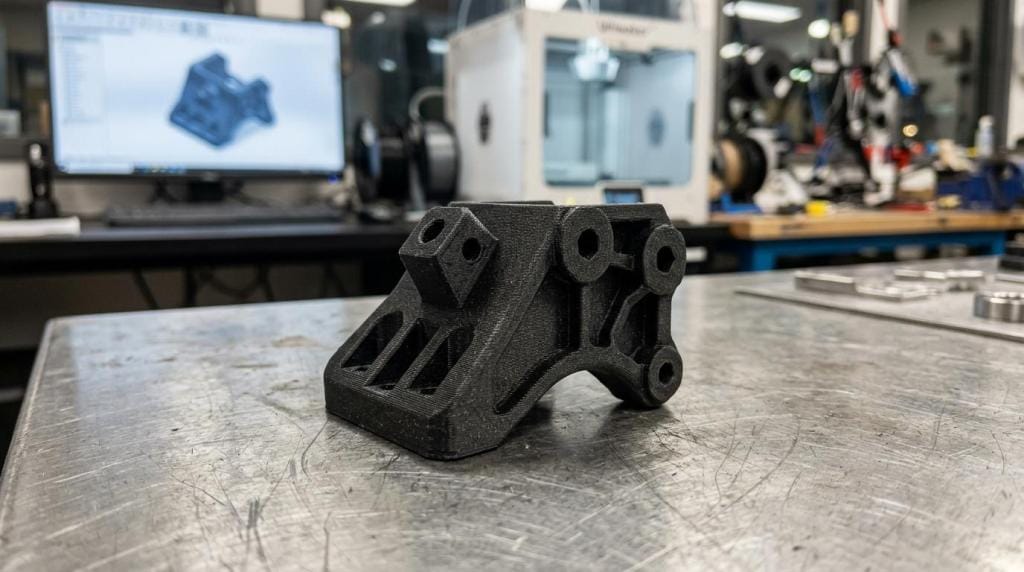
When a product is ready to move beyond prototyping, the next manufacturing decision can shape cost, timing, and commercial momentum. This is the point where two terms often appear in the same conversation: bridge manufacturing and short-run manufacturing.
They are closely related, but they are not the same. One is usually a temporary production strategy that buys time before full-scale manufacture. The other is a broader low-volume production model that may stay in place for the life of a product. For engineering teams, procurement managers, and operations leaders, that distinction matters.
What bridge manufacturing means in production planning
Bridge manufacturing is a transition method. It sits between prototype validation and mass production, helping a business supply real parts while permanent tooling, full production capacity, or final process approval is still being prepared.
This approach is common when product demand arrives before traditional manufacturing is ready. A design may be approved, customer orders may already be in place, or field trials may have moved into commercial deployment. In those moments, waiting for hard tooling can slow the entire launch.
That delay is not small. In conventional production, a mould can cost more than $30,000 and take eight weeks or more to produce. If the design is still shifting, or if early demand is uncertain, that commitment may be difficult to justify.
Bridge manufacturing gives teams a more flexible path:
- Launch timing: get saleable or functional end-use parts into the field earlier
- Design stability: keep room for revisions before locking in expensive tooling
- Cash flow: avoid heavy upfront tooling spend while demand is still being proven
- Reduced inventory risk
- Faster validation in real operating conditions
In practice, bridge manufacturing is often tied to additive manufacturing, CNC machining, laser cutting, or other digital production methods that work directly from CAD files.
What short-run manufacturing means for low-volume parts
Short-run manufacturing is the broader category. It refers to low-volume production, usually with limited or no dedicated tooling, where parts are made in relatively small batches for commercial use.
Unlike bridge manufacturing, short-run production does not always lead to mass manufacturing. Sometimes it does. Sometimes it never needs to.
That makes short-run manufacturing especially useful for products with modest demand, high customisation, regional supply needs, or frequent design updates. Spare parts, industrial fixtures, robotics end-of-arm tooling, custom housings, medical accessories, and mining support components all fit comfortably in this space.
A short run could mean tens of parts, hundreds, or in some cases several thousand, depending on the geometry, material, and production method. With industrial 3D printing, many applications now sit comfortably within that range, especially where performance matters more than unit economics at very high scale.
Bridge manufacturing vs short-run manufacturing: the core difference
The clearest way to separate the two is by intent.
Bridge manufacturing exists to bridge a gap. It is temporary by design. Short-run manufacturing exists to produce low volumes efficiently, whether that is temporary or ongoing.
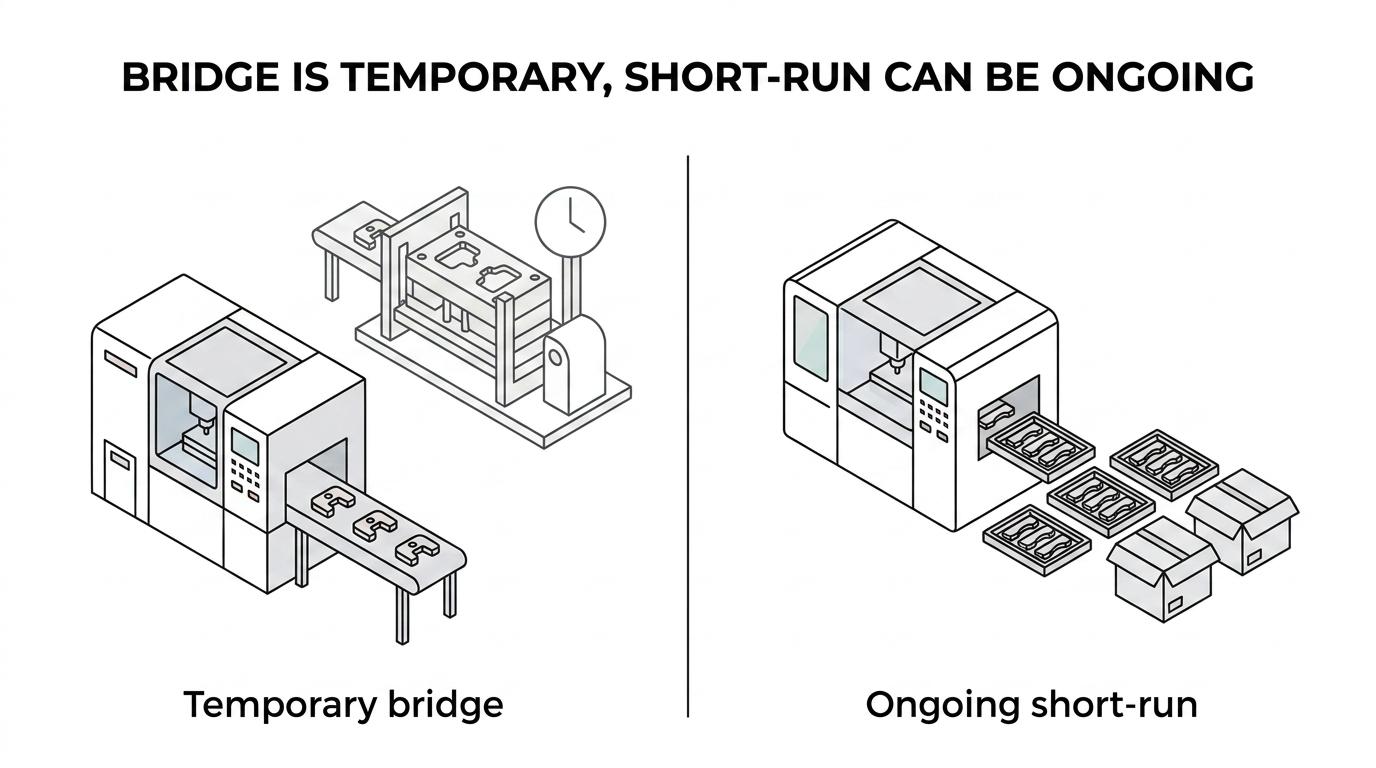
That difference shapes planning decisions across purchasing, scheduling, and engineering change control.
| Factor | Bridge manufacturing | Short-run manufacturing |
|---|---|---|
| Primary purpose | Support production before mass manufacturing is ready | Produce low-volume parts efficiently |
| Typical duration | Temporary | Temporary or ongoing |
| Relationship to tooling | Usually delays tooling until the design or demand is proven | Often avoids tooling altogether |
| Design changes | Common during the bridge period | Common, but not always expected |
| Demand profile | Early launch, ramp-up, supply gap | Niche demand, custom demand, recurring small batches |
| Best fit | Products moving towards scale | Products that may stay low-volume |
Many businesses use both. A product may begin with bridge manufacturing during launch, then move into moulded or machined high-volume production. Another product may remain in short-run production permanently because annual demand never justifies hard tooling.
Why tooling costs and lead times push teams towards digital manufacturing
Low-volume production decisions are rarely just about part count. They are usually about timing, risk, and how much certainty the business really has.
If the design is still changing, tooling can lock in assumptions too early. If market demand is unclear, a large tooling spend can feel premature. If a production line is down, the fastest available process matters more than perfect long-term unit cost.
This is where digital manufacturing becomes commercially attractive. Processes built around digital files can cut weeks out of the schedule and remove the need for moulds, dies, or dedicated fixtures in the early stages of production.
A few triggers tend to make bridge or short-run manufacturing the sensible option:
- Tooling delay: mass production cannot start quickly enough
- Low annual volume: the product will not absorb tooling cost well
- Frequent design revision: parts may change after the first commercial release
- Service parts demand: older equipment needs replacements in unpredictable quantities
- Line-down emergencies
- Pilot programs and field deployments
For Australian manufacturers, there is another consideration: logistics. When imported tooling or offshore batch production adds freight risk and extra lead time, local low-volume production can provide much tighter control.
Where 3D printing fits into bridge manufacturing and short-run production
Industrial 3D printing is not the only method used for these applications, though it has become one of the most useful. Its strengths are clear: no tooling, rapid iteration, complex geometry, and strong suitability for low-volume end-use parts.
That makes it well matched to both categories.
In bridge manufacturing, 3D printing can keep a product moving while permanent production tooling is being developed. In short-run manufacturing, it can become the production method itself, especially when geometry is complex or annual demand remains relatively low.
This is why additive manufacturing has moved beyond prototype departments and into operational supply chains. Automotive teams use it for short-run final parts and fixtures. Robotics teams use it for EOAT components and custom brackets. Medical and defence applications often value agility, traceability, and small-batch control. Mining and maintenance teams use it to replace hard-to-source components faster.
One sentence captures the shift well: low-volume production is no longer a stopgap, it is now a mature manufacturing strategy.
Materials and part types that suit low-volume additive production
Not every part belongs in additive manufacturing, but many industrial parts do, especially when performance requirements line up with the strengths of engineering polymers and digital workflows.
Materials like PA12-CF, ASA, TPU, ESD-safe polymers, and heat-resistant materials open the door to production-ready applications that once would have been pushed straight into tooling. The result is a much wider range of practical end-use use cases.
Typical candidates include:
- Custom machine covers
- Jigs and fixtures
- Replacement housings
- Cable guides and mounts
- Robotics tooling: lightweight EOAT parts and brackets
- Automotive applications: ducts, clips, shrouds, and test components
- Mining maintenance: low-volume replacement parts for legacy equipment
- Medical support parts: device accessories and fit-for-purpose enclosures
The strongest candidates often share the same traits: moderate volume, high part value, design complexity, or urgency.
How to choose between bridge manufacturing and short-run manufacturing
The choice becomes easier when the business asks the right questions early. That means looking past simple per-part cost and focusing on total project economics.
If the product is likely to move into high volumes soon, bridge manufacturing is often the right frame. If the product may remain niche, configurable, or demand-led, short-run manufacturing may be the better long-term model.
A practical decision framework usually includes these points:
- Is high-volume production definitely planned, or only possible?
- How stable is the current design?
- What is the real cost of waiting for tooling?
- How predictable is annual demand?
- Does the part need to be produced locally for speed or supply security?
If the answers point towards uncertainty, urgency, or ongoing low volumes, digital manufacturing tends to compare well.
Why bridge manufacturing matters during product launch and supply disruption
Launch windows are unforgiving. Miss one, and the commercial cost can exceed the manufacturing saving gained by waiting for the “ideal” process.
Bridge manufacturing protects momentum. It allows a business to release product, support early adopters, validate field performance, and respond to demand while larger-scale production is still being prepared. That flexibility is especially valuable when regulatory steps, tooling sign-off, or supplier onboarding are still in motion.
It also has a second role that is often overlooked. Bridge manufacturing can act as a supply continuity tool when standard production is interrupted. A supplier issue, damaged tooling set, shipping delay, or line-down event can all create a sudden need for low-volume replacement production. In those cases, a bridge strategy is less about product launch and more about keeping operations moving.
Some manufacturing partners now support emergency quoting and very rapid turnaround for urgent part requirements, including expedited production within 24 to 48 hours for suitable jobs. That kind of response can materially reduce downtime exposure.
Why short-run manufacturing is often the smarter permanent option
Not every product wants to become a mass-manufactured product. Some products are too specialised. Some serve small installed bases. Some are revised so often that tooling never delivers a meaningful return.
Short-run manufacturing fits those realities without apology.
It supports a production model that is leaner and more responsive. Instead of producing large batches to justify tooling, businesses can make what they need, when they need it. That can improve inventory control, reduce obsolete stock, and make engineering changes far less disruptive.
For procurement and maintenance teams, this matters just as much as it does for product development. A spare part that can be made on demand is often more valuable than a cheaper part that requires months of planning or warehousing.
What to look for in a low-volume manufacturing partner
The process is only part of the equation. The production partner matters just as much.
A capable provider should be able to assess geometry, material requirements, environmental exposure, finish expectations, and batch size without forcing every job into the same workflow. Low-volume production works best when engineering input and manufacturing capability sit close together.
That is why many teams look for a partner that can offer:
- Fast quoting
- Industrial-grade materials
- Clear technical guidance
- Local manufacturing support with reliable shipping
- Application advice: whether a part suits bridge manufacturing, short-run production, or another process
- Design input: CAD guidance that improves printability, strength, and repeatability
- Production flexibility: prototypes, small batches, and urgent replacement parts through one workflow
For businesses across Australia, local access can be particularly valuable when speed, communication, and freight reliability affect the project outcome.
How bridge and short-run manufacturing fit modern production strategy
The old view treated low-volume manufacturing as a temporary compromise before “real” manufacturing began. That view no longer holds.
Bridge manufacturing is a powerful transition tool for products on the path to scale. Short-run manufacturing is a durable production model in its own right. Both reduce exposure to tooling cost, compress lead times, and create room for better decisions.
For manufacturers working with complex parts, variable demand, or urgent operational needs, that is not a fallback plan. It is a sharper way to build.