Automotive Rapid Tooling: How 3D Printing Is Accelerating Australian Automotive Manufacturing
Introduction: From Months to Days
In the automotive industry, tooling is everything. Jigs, fixtures, gauges, moulds, and end-of-arm tooling (EOAT) ensure every component meets specification, every weld is precise, and every assembly is repeatable. Traditionally, these tools are machined from steel or aluminium — a process taking weeks or months and costing thousands.
3D printing is rewriting that timeline. At Partmade3D, we produce automotive rapid tooling in days, not months, at a fraction of traditional costs. For Australian automotive manufacturers, aftermarket specialists, and motorsport teams, this isn’t just convenient — it’s competitive advantage.
What Is Rapid Tooling?
Rapid tooling uses additive manufacturing (3D printing) to produce tools, jigs, fixtures, and moulds quickly and economically. Unlike traditional machining, there’s no need for:
- Extensive CAD/CAM programming
- Multiple machining operations
- Hard tooling and setup
- Material waste from subtractive processes
We print the tool directly from your CAD file, often overnight, ready for use the next morning.
Types of Automotive Rapid Tooling We Produce
Assembly Jigs & Fixtures
- Door panel alignment jigs — ensure consistent panel gaps during assembly
- Dashboard installation fixtures — hold complex interior components during fitting
- Wiring harness routing guides — prevent chafing and ensure correct clip placement
- Seat and trim alignment tools — maintain ergonomic positioning across production runs
Welding & Bonding Fixtures
- Resistance welding electrode holders — custom geometries for complex joint access
- MIG welding jigs — hold panels in correct position for robotic or manual welding
- Adhesive application fixtures — control bead placement for structural bonding
- Spot weld inspection gauges — verify weld quality and location
End-of-Arm Tooling (EOAT)
- Vacuum gripper arrays — customised suction cup layouts for irregular parts
- Pneumatic gripper fingers — lightweight, complex geometries impossible to machine
- Part orientation tools — ensure correct pickup angle for robotic placement
- Quick-change adapters — compatible with major robot brands (ABB, KUKA, Fanuc, Universal Robots)
Inspection & Quality Control Gauges
- Go/no-go gauges — rapid verification of critical dimensions
- Gap and flushness checking tools — match panel alignment to design intent
- Optical scanning fixtures — hold parts in known positions for CMM or laser scanning
- Leak test sealing tools — custom seals for pressure and vacuum testing
Moulds & Patterns
- Vacuum forming moulds — for interior trim, dash pads, and exterior panels
- Composite layup tools — for carbon fibre and fibreglass motorsport components
- Silicone mould masters — for casting rubber seals, grommets, and bushings
- Investment casting patterns — for metal components requiring complex internal geometries
Materials for Automotive Rapid Tooling
The right material depends on the application — load, temperature, chemical exposure, and required lifespan.
Carbon Fibre Nylon (PA-CF)
- Best for: Structural jigs, EOAT, inspection fixtures
- Properties: High stiffness, low weight, excellent dimensional stability, good wear resistance
- Temp range: Up to 150°C
- Lifespan: 1,000–5,000 cycles depending on load
Glass Fibre Nylon (PA-GF)
- Best for: Welding fixtures, medium-load jigs
- Properties: High strength, chemical resistance, lower cost than carbon fibre
- Temp range: Up to 120°C
- Lifespan: 500–2,000 cycles
ABS/ASA
- Best for: Light-duty fixtures, prototype tooling, outdoor applications
- Properties: Impact resistant, easy to machine/tap, ASA is UV stable
- Temp range: Up to 90°C
- Lifespan: 200–1,000 cycles
Polycarbonate (PC)
- Best for: High-temp fixtures, transparent inspection tools
- Properties: Extremely tough, heat resistant, can be polished transparent
- Temp range: Up to 135°C
- Lifespan: 500–3,000 cycles
Metal 3D Printing (Steel, Aluminium, Titanium)
- Best for: High-volume production tooling, welding fixtures, permanent EOAT
- Properties: Full metal strength, machinable, weldable, indefinite lifespan
- Temp range: 200°C+
- Lifespan: Essentially unlimited with maintenance
The Business Case: Cost & Time Comparison
Table
| Tool Type | Traditional Machining | 3D Printed Rapid Tooling | Savings |
|---|---|---|---|
| Assembly jig (medium complexity) | $3,500 / 4 weeks | $450 / 3 days | 87% cost, 89% time |
| EOAT vacuum gripper | $2,800 / 3 weeks | $320 / 2 days | 89% cost, 90% time |
| Inspection gauge set (5 pieces) | $6,000 / 6 weeks | $890 / 4 days | 85% cost, 90% time |
| Vacuum forming mould | $8,500 / 8 weeks | $1,200 / 5 days | 86% cost, 91% time |
| Composite layup tool | $12,000 / 10 weeks | $2,100 / 6 days | 83% cost, 91% time |
Based on Partmade3D client projects, 2024–2026. Actual savings vary by complexity and volume.
Real-World Applications: Australian Automotive Success Stories
Case Study 1: Brisbane EV Startup — Battery Module Assembly A local electric vehicle conversion company needed custom jigs to align battery modules during pack assembly. Tolerances were tight (+/- 0.2mm), and the jig needed to accommodate three different module sizes as the design evolved.
Traditional machining quote: $14,000, 8 weeks. Partmade3D solution: Carbon fibre nylon jigs with interchangeable locating pins. Total cost: $2,400. Delivery: 5 days. The modular design allowed the client to swap pins as battery designs changed — something impossible with a machined steel jig.
Case Study 2: Queensland Motorsport Team — Carbon Fibre Moulds A V8 Supercars team needed rapid turnaround on front splitter moulds for aerodynamic testing. Each design iteration required new tooling.
Traditional aluminium mould: $6,500, 3 weeks. Partmade3D solution: High-temp resin moulds with composite reinforcement. Cost per mould: $780. Turnaround: 48 hours. The team tested 6 design iterations in the time it would have taken to machine one traditional mould.
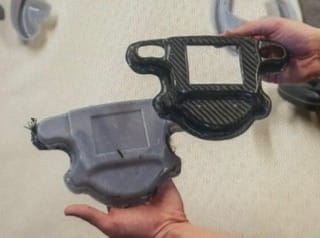
Case Study 3: Sydney Aftermarket Manufacturer — Custom Gauge Pods A company producing aftermarket gauge pods for 4WDs needed vacuum forming moulds for 15 different vehicle models. Low volumes (50–100 units per model) made machined aluminium uneconomical.
Partmade3D printed PETG moulds with integrated cooling channels. Cost per mould: $340. Each mould produced 200+ parts before replacement. Total tooling investment: $5,100 vs. $52,500 for aluminium. Time to market: 3 weeks vs. 6 months.
Design Principles for Effective Rapid Tooling
Design for Additive Manufacturing (DfAM)
Unlike machined tools, 3D printed tooling benefits from:
- Internal lattice structures — reduce weight by 40–60% while maintaining stiffness
- Conformal cooling channels — for moulds, integrate cooling passages that follow the part geometry, impossible with drilling
- Integrated features — combine multiple components into one printed piece (e.g., a jig with built-in clamps and locators)
Tolerance Management
- FDM printing: +/- 0.3mm typical, +/- 0.1mm achievable with fine-tuned settings
- SLA printing: +/- 0.1mm typical
- Metal printing: +/- 0.05mm typical
For tighter tolerances, we design in machining allowances — print close to final size, then finish critical surfaces with light machining.
Wear & Durability Strategies
- Replaceable inserts — print high-wear areas as separate, easily replaced components
- Surface treatments — epoxy coatings, metal plating, or infiltration for enhanced wear resistance
- Reinforcement — embed threaded inserts, bushings, or steel pins in printed structures
Integration with Existing Workflows
Our rapid tooling is designed to slot into your current manufacturing environment:
- CAD compatibility — we accept STEP, IGES, STL, native SolidWorks, Inventor, and Fusion 360 files
- Robot compatibility — EOAT designed for your specific robot model and controller
- CMM integration — inspection fixtures include reference datums compatible with your metrology equipment
- Production system compatibility — tooling designed to your existing pallet sizes, conveyor heights, and workstation layouts
Frequently Asked Questions
How many cycles will a 3D printed tool last? Depends on material and load. Light-duty ABS fixtures: 200+ cycles. Carbon fibre nylon jigs: 1,000–5,000 cycles. Metal printed tools: essentially unlimited. We’ll advise the right material for your expected volume.
Can 3D printed tooling handle welding sparks and heat? With correct material selection, yes. Carbon fibre nylon and metal printing withstand welding environments. For very high heat exposure, we design shields or specify metal options.
Is 3D printed tooling accurate enough for automotive tolerances? Absolutely. We routinely achieve tolerances of +/- 0.1mm, suitable for most automotive assembly and inspection applications. For critical dimensions, we combine printing with precision machining of locating surfaces.
What if my design changes frequently? This is where rapid tooling shines. Design changes are simply a CAD update and reprint — no machining setup, no tooling modification costs. Perfect for prototyping and low-volume production.
Can you print tools for my specific robot? Yes. We design EOAT for all major brands. Send us your robot model, payload capacity, and gripper requirements. We’ll design, print, and deliver a complete solution.
Conclusion: Speed Is the New Competitive Edge
Australian automotive manufacturing — whether OEM, aftermarket, motorsport, or EV innovation — moves fast. Traditional tooling timelines don’t match modern product development cycles. 3D printed rapid tooling from Partmade3D closes that gap.
Faster iterations. Lower tooling costs. Lighter tools. Custom geometries impossible any other way. Whether you need one jig or a complete tooling suite, we’re your Brisbane-based rapid manufacturing partner.
Have a tooling challenge?Upload your CAD file for a free assessment or call our automotive engineering team. Let’s accelerate your production.
Partmade3D — Automotive rapid tooling, jigs, fixtures, and EOAT. 3D printed in Brisbane. Delivered across Australia and New Zealand.