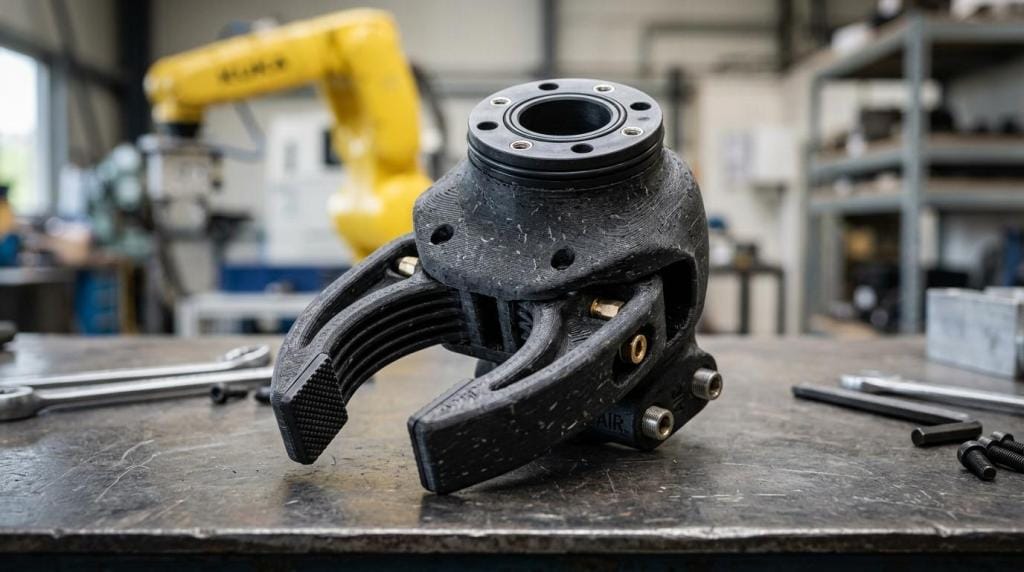
Carbon fibre 3D printing has moved well beyond the prototype bench. It is now a serious production tool for engineers who need parts that are light, rigid, dimensionally stable, and fast to manufacture.
That shift matters because many manufacturing problems are not really about making a part at the lowest theoretical unit cost. They are about getting the right part, in the right material, on the right timeline, with enough performance to improve a process, reduce machine downtime, or move a design into testing without delay. Carbon fibre reinforced additive manufacturing sits squarely in that space.
What carbon fibre 3D printing means in practice
Not all carbon fibre 3D printing is the same. In industrial use, the term usually refers to two broad categories: carbon-fibre-filled thermoplastics and continuous fibre reinforced composites.
The first category uses chopped or short carbon fibres mixed into a polymer such as nylon or PA12. These materials are widely used because they print more easily than traditional laminated composites while still offering a meaningful jump in stiffness and dimensional stability over standard engineering plastics.
The second category uses continuous strands of carbon fibre placed into the part during printing. This can push mechanical performance much further, especially when the fibre path is designed around the actual loads the part will see in service.
The distinction matters because the use case often decides the material route. A fixture, gripper body, or inspection tool may perform exceptionally well in a short-fibre reinforced polymer. A highly loaded structural part may call for continuous reinforcement or a different manufacturing method altogether.
| Carbon fibre 3D printing type | Typical process | Best suited to | Main advantage |
|---|---|---|---|
| Short carbon-fibre-filled thermoplastics | FDM/FFF and similar extrusion systems | Tooling, fixtures, brackets, housings, functional prototypes | Stiffer and more stable than unfilled polymers |
| Continuous carbon fibre reinforcement | Specialised composite printing systems | High-performance structural or semi-structural parts | Stronger and stiffer reinforcement along load paths |
Carbon fibre 3D printing use cases in robotics and automation
Robotics is one of the clearest fits for carbon fibre 3D printing. Every gram removed from an end effector can improve robot speed, usable payload, and energy efficiency. That benefit is immediate and measurable on the factory floor.
A heavy metal gripper may do the job, yet it also limits acceleration and places more demand on the robot arm. A carbon-fibre-reinforced printed alternative can reduce mass while keeping enough stiffness for repeatable handling. That makes it attractive for custom EOAT, sensor mounts, vacuum manifolds, cable guides, and machine-tending tools.
This is especially useful where the tooling changes often. Manufacturers rarely want to wait weeks for machined tooling each time a product line changes, a packaging format shifts, or a new cell is commissioned. Additive manufacturing shortens that cycle dramatically.
Common robotics applications include:
- End-of-arm tooling
- Soft jaws
- Vacuum grippers
- Sensor brackets
- Vision system mounts
- Lightweight guarding components
For a team building robotic automation, the gain is not only lower weight. It is also the freedom to integrate multiple functions into one printed part, including air channels, mounting points, alignment features, and cable routing.
Carbon fibre 3D printing use cases in automotive and motorsport
Automotive programs reward speed. Design iterations move quickly, packaging is tight, and tooling needs to keep pace with development. Carbon fibre 3D printing suits that environment because it can produce functional parts without waiting for moulds or long machining lead times.
In vehicle development, carbon-fibre-filled polymers are often used for ducting, sensor mounts, prototype housings, brackets, jigs, and line-side fixtures. These parts benefit from good stiffness and low weight, but the bigger value is usually turnaround. Engineers can test a concept, adjust geometry, and print a revised design in days instead of restarting a conventional tooling process.
Motorsport pushes the case even further. Teams often need low-volume, high-performance components where design flexibility matters more than scale. Printed carbon fibre parts can support pit tooling, aerodynamic test components, cable management hardware, and lightweight auxiliary mounts that would be expensive or slow to machine repeatedly.
A strong automotive use case usually has at least one of these characteristics:
- Low production volume: the cost of moulding tools is hard to justify
- Rapid design change: CAD updates need to turn into parts quickly
- Weight sensitivity: lighter assemblies improve performance or installation
- Complex geometry: ducts, channels, and mounting features are hard to machine efficiently
Carbon fibre 3D printing use cases in aerospace and defence
Aerospace and defence applications demand caution, qualification, and disciplined engineering, yet they also reward lightweight design and rapid iteration. That makes carbon fibre 3D printing valuable for selected non-critical and semi-structural applications, especially in tooling, support hardware, UAV systems, and ground equipment.
Inspection jigs, drill guides, assembly fixtures, protective housings, avionics brackets, and custom ducts are well suited to additive manufacturing. These parts often need to be light, stable, and tailored to a specific platform. Printing them in carbon-fibre-reinforced materials can reduce manual handling effort and shorten production support timelines.
Uncrewed systems are another strong match. Drones and UAV platforms benefit from every gram saved, and the low-to-medium production volumes often suit additive manufacturing. Brackets, payload mounts, internal frames, antenna supports, and aerodynamic housings can all benefit from printed composite materials when the design is matched to the process.
Not every aerospace part belongs in this category. Certification, fatigue behaviour, thermal exposure, impact requirements, and inspection criteria all matter. Even so, carbon fibre 3D printing is already highly useful where speed, custom geometry, and weight reduction are priorities.
Carbon fibre 3D printing use cases in medical devices and industrial equipment
Medical applications tend to focus on external devices, instruments, and custom support tools rather than implantable parts. Carbon fibre reinforced materials are attractive here because they can produce light, rigid, application-specific forms with a high degree of customisation.
That can include external prosthetic components, orthotic supports, surgical guides, device housings, and anatomy-related aids used in planning or setup. In many of these cases, the real advantage is not simply material strength. It is the ability to produce a patient-matched or procedure-specific part without committing to expensive traditional tooling.
Industrial equipment presents a different but equally practical set of use cases. Many factories need replacement covers, inspection gauges, machine brackets, locator tools, trays, wear-resistant handling parts, and maintenance aids. These are often difficult to source, uneconomical to machine in small quantities, or no longer supported by the original OEM.
That is where carbon fibre 3D printing becomes a strong option for maintenance and production teams. It allows older assets to stay in service, supports local manufacturing of custom parts, and can reduce the stock held for rarely used spares.
Why carbon fibre 3D printing often beats conventional methods
The strongest case for carbon fibre 3D printing is not that it replaces every metal or every composite layup. It is that it solves a narrow but very valuable set of manufacturing problems exceptionally well.
A machined aluminium bracket may still be the right answer for some applications. Injection moulding still dominates at high production volumes. Traditional composite layup remains important for many large or highly certified structures. Yet none of those methods is ideal when parts need to be customised, produced in low volumes, or revised repeatedly during development.
Carbon fibre 3D printing is most persuasive when it can remove several constraints at once:
- Tooling cost: no mould required for low-volume production
- Lead time: faster path from CAD to usable part
- Weight reduction: lower mass than many metal alternatives
- Part consolidation: fewer fasteners and fewer assembly steps
- Inventory reduction: print on demand rather than hold slow-moving stock
That mix is why the technology continues to gain ground in production tooling, maintenance, robotics, and specialist manufacturing.
Material and design considerations for carbon fibre 3D printed parts
Good results start with realistic expectations. Carbon fibre reinforcement improves performance, but it does not remove the need for sound design practice. Load direction, layer orientation, wall thickness, inserts, heat exposure, and fastening strategy all influence whether a printed part succeeds in service.
Engineers also need to think carefully about the matrix material, not just the fibre. A carbon-fibre-filled nylon behaves differently from an ESD-safe or heat-resistant material, and different production environments demand different properties. In a mining or automation setting, wear resistance and stiffness may matter most. In electronics handling, ESD control may be essential. In outdoor service, UV stability and weather resistance enter the picture.
The most reliable design reviews usually focus on a few practical questions:
- Load path: where does the part actually carry force?
- Environment: heat, chemicals, UV, abrasion, moisture
- Tolerance requirement: visual fit is different from precision alignment
- Assembly method: bolts, inserts, clips, adhesive, or integrated features
- Service life: prototype trial, production aid, or long-term end use
This is where an industrial additive manufacturing partner can add real value. Design support, material selection, CAD templates, and quick quoting can prevent the common mistake of choosing carbon fibre for its reputation rather than for its actual fit to the application.
Carbon fibre 3D printing for Australian manufacturers and engineering teams
Australian manufacturers often face a practical mix of pressures: distance from overseas suppliers, urgent maintenance needs, variable production volumes, and the need to keep projects moving without long procurement cycles. Carbon fibre 3D printing fits this environment well because it supports local, on-demand production for parts that would otherwise be slow or costly to source.
That matters in cities with dense industrial activity, but it matters just as much for regional operations where downtime can be expensive and replacement lead times can stretch out quickly. A lightweight tooling component, robotic gripper, machine bracket, or functional prototype does not need to become a global sourcing problem.
For organisations looking at industrial additive manufacturing in this space, a capable provider should offer more than printing alone. Material choice, engineering resources, production readiness, and fast response times all shape whether the part works in the field.
PartMade3D positions itself around that broader industrial requirement, with services spanning production parts, tooling, prototypes, replacement parts, and custom manufacturing. For teams assessing carbon-fibre-capable workflows, the useful signals are practical ones: access to industrial-grade materials like PA12-CF, support for rapid quoting, engineering resources, and the ability to deliver locally across Australia while supporting international shipping where needed.
Carbon fibre 3D printing is no longer a niche option reserved for specialist labs. It is a mature manufacturing tool for organisations that want lighter tooling, faster design cycles, and more control over low-volume, high-value parts. When the application is chosen well, it can shift a project from delay and compromise to progress and measurable performance.