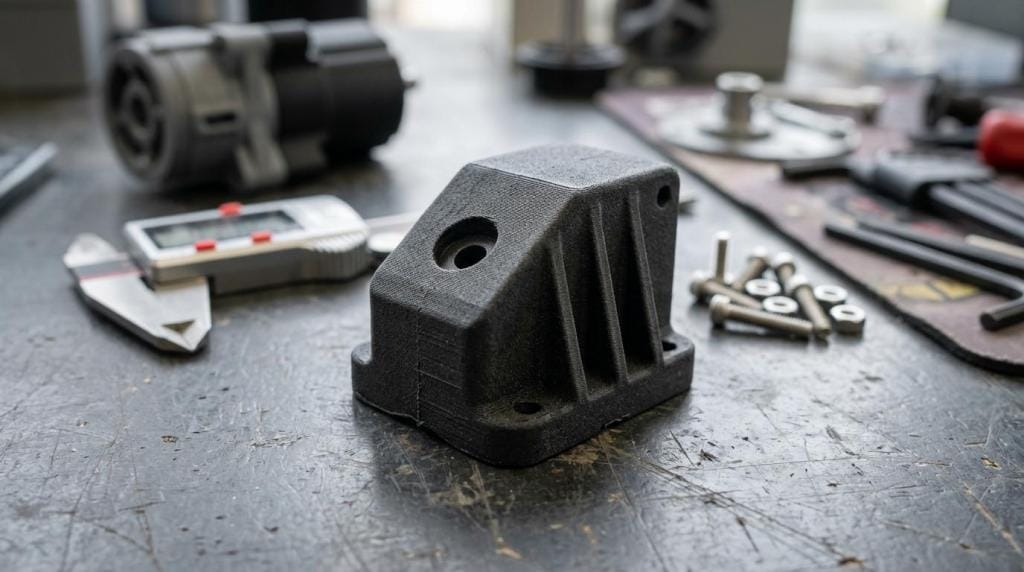
Industrial design prototyping is where ideas stop being abstract and start facing reality. A concept that looks convincing on screen can still fail at assembly, flex too much under load, trap heat, or take far too long to manufacture. Prototypes close that gap early, while changes are still affordable.
That is why additive manufacturing has become such a strong fit for industrial design work. According to NIST, additive manufacturing supports rapid prototyping and repeated design iterations without the lead time and cost of tooling. For teams building new products, replacement parts, fixtures, housings, medical devices, or robotic components, that changes the pace of decision-making.
Industrial design prototyping in product development
Industrial design prototyping is often described as making an early model of a product. In practice, it is much more specific than that. It is a structured way to test shape, fit, function, usability, manufacturability, and risk before a design is released for production.
A good prototype answers a defined question. Will the housing clear the motor? Can the latch survive repeated use? Is the hand grip comfortable after ten minutes? Will the bracket hold alignment under vibration? When teams know the question, they can choose the right prototype method instead of printing a part simply because they can.
This is where many projects improve quickly. Rather than waiting for a “perfect” design file, engineers and designers can test assumptions in stages. One prototype may be used for visual review. The next may be used for assembly checks. Another may be built in a stronger polymer for real load testing.
That staged approach matters because product development rarely fails in one dramatic moment. It usually slows down through small misses, unclear communication, and late design changes.
Additive manufacturing benefits for industrial design prototyping
Traditional prototype routes still have a place, especially when the process needs to mirror final production exactly. Yet for many industrial design tasks, additive manufacturing removes friction at the point where teams need speed most. NIST notes that rapid iterations can resolve design issues that might otherwise take weeks or months longer through conventional approaches tied to tooling.
This matters well beyond the prototype bench. Faster iteration can reduce rework across procurement, maintenance, manufacturing, and compliance teams. It also allows more ambitious geometry. Features like internal channels, lightweight lattice regions, cable guides, sensor mounts, and organic forms are often easier to build additively than with subtractive or mould-based methods.
A practical way to think about the value is this:
- Speed: prototype cycles can move from long tooling waits to short digital revisions
- Cost control: early parts can be produced without committing to expensive hard tooling
- Complexity: intricate geometry is often easier to test than it would be with conventional prototype methods
- Customisation: one-off or low-volume parts can be adjusted without resetting the whole manufacturing plan
An academic medical-device study published in 2019 found that in-house 3D printing supported rapid, low-cost fabrication and helped teams keep tight design-to-prototype timing while preserving customisation freedom. The setting was medical, though the lesson is broader: when iteration is easy, design quality tends to improve because more ideas are tested under real conditions.
Prototype materials and processes for industrial design work
Not every prototype needs the same process, and not every process answers the same design question. Industrial design prototyping works best when the prototype method matches the job to be done.
SLA resin printing is often chosen when surface finish, fine detail, and visual quality matter. It suits presentation models, ergonomic review parts, and complex forms where small features must be checked carefully. SLS printing is often preferred for tougher functional prototypes, especially when parts need to be support-free and geometrically complex. FDM remains useful for larger concept models, quick fit checks, and economical iteration. Metal additive manufacturing becomes relevant when thermal, structural, or end-use demands move beyond polymers.
Material choice matters just as much. PA12-CF, a nylon 12 composite reinforced with chopped carbon fibre, is a strong option for functional prototyping where stiffness is needed. TPU suits flexible components, bumpers, seals, and grips. ASA is often selected for outdoor exposure. ESD-safe and heat-resistant materials matter when electronics, elevated temperatures, or specialised industrial environments are part of the brief.
| Prototype goal | What matters most | Typical process or material fit |
|---|---|---|
| Visual design review | Surface finish, detail, appearance | SLA resin |
| Assembly and fit check | Dimensional accuracy, speed, cost | FDM or SLS |
| Functional bracket or housing | Strength, stiffness, repeatability | SLS, PA12-CF |
| Flexible component | Elastic response, durability | TPU |
| Outdoor enclosure | UV resistance, weather stability | ASA |
| Electronics-related fixture | Static control | ESD-safe polymer |
| High-temperature test part | Thermal performance | Heat-resistant polymer or metal |
The point is not to chase the most advanced option each time. It is to choose the least complicated path that still gives a trustworthy answer.
Functional prototyping and appearance prototyping
One of the most useful distinctions in industrial design prototyping is the split between appearance prototypes and functional prototypes. They may look similar in a meeting, yet they serve very different purposes.
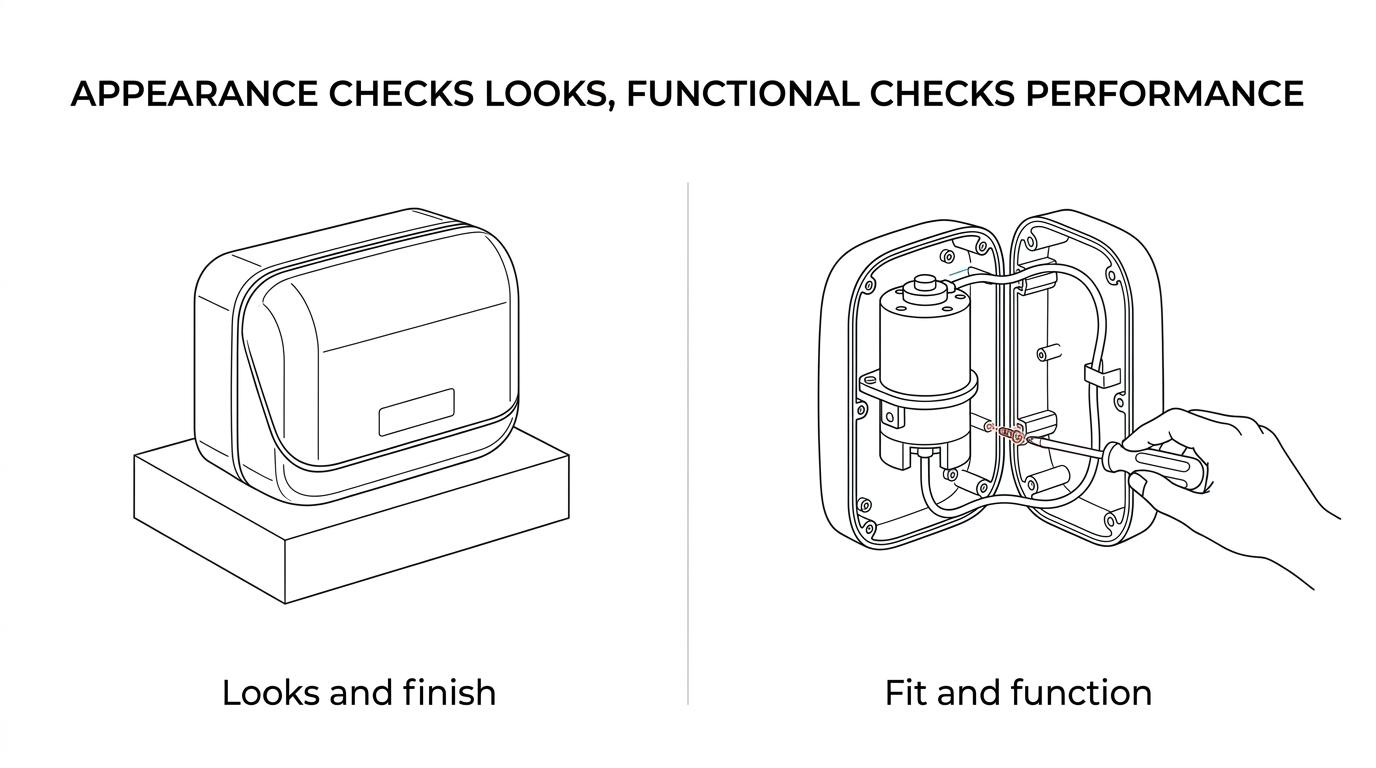
Appearance prototypes help teams review size, surface finish, branding, human interaction, and perceived quality. They are valuable for stakeholder feedback, early market validation, and design sign-off. A polished appearance model can also reveal proportion issues that are hard to spot in CAD.
Functional prototypes are different. They exist to be handled, fitted, stressed, fastened, heated, flexed, or cycled. They can expose wall thickness problems, poor fastener placement, weak clip geometry, or awkward cable routing long before production starts. In many industrial settings, that is where the real savings appear.
Common functional checks include:
- fit and clearance
- assembly sequence
- tool access
- cable routing
- load path review
- thermal exposure
Strong projects usually use both prototype types, just not at the same time or for the same reason.
Industrial design prototyping mistakes that slow projects
Most delays in prototyping are not caused by the printer. They come from unclear objectives, poor file preparation, and selecting a material based on habit rather than performance.
A prototype should never be asked to prove everything at once. If one part is expected to validate aesthetics, impact resistance, UV stability, exact production tolerances, and end-user comfort in a single build, the team usually gets a muddled result. Separate the questions. Build around the decision that matters next.
Another common issue is choosing based on looks alone. A smooth resin part may photograph beautifully, yet it may not be suitable for a bracket test. A quick FDM print may be excellent for a packaging check, yet it may give the wrong impression of a final consumer-facing product. The method should serve the decision.
The most frequent problems tend to look like this:
- Testing too late: teams wait for a polished CAD model before printing anything, which shifts risk downstream
- Choosing on finish alone: visual appeal takes priority over the mechanical or thermal requirement
- Ignoring downstream use: the prototype is not matched to the real operating environment
- Locking geometry too early: features are treated as fixed before enough physical feedback has been gathered
These are preventable issues, and the fix is usually simple: define the test, define the environment, then select the process.
Faster prototype cycles for Australian engineering teams
For Australian manufacturers and engineering teams, speed has a practical dimension. Time zones, freight lead times, imported tooling delays, and urgent maintenance requirements can all slow a project when prototype work is treated as a peripheral task rather than part of core product development.
Local additive manufacturing support can tighten those loops. Shorter delivery paths make it easier to test a concept in Brisbane, revise it in Melbourne, review it with a procurement team in Perth, and send the updated file for another build without losing weeks. That is especially valuable when prototype work supports mining operations, robotics integration, defence programs, or production line maintenance, where downtime can carry a much higher cost than the part itself.
Industrial service providers in this market often support rapid prototyping through processes including SLA, SLS, FDM, metal, and multi-material printing, with technical data resources to help teams compare materials like PA12-CF, TPU, ASA, ESD-safe, and heat-resistant options. When those tools are paired with clear CAD templates and fast quoting, prototype cycles become more predictable.
Sometimes the fastest route to a better design is simply getting a test part into someone’s hands this week.
Information needed for an industrial prototype quote
A faster quote usually starts with better inputs. If the brief is vague, the service team has to guess what matters. That creates back-and-forth, and the project loses momentum before production begins.
It helps to provide the CAD file, target dimensions, quantity, intended use, environmental conditions, and the reason the prototype exists. If the part is for an assembly check, say so. If it must survive heat, impact, chemicals, UV exposure, or repetitive loading, include that too. A prototype built for the wrong condition can still be accurate and still be the wrong answer.
The most useful quote requests often include:
- Primary goal: visual review, fit check, functional test, or pre-production validation
- Operating conditions: indoor, outdoor, heat, vibration, moisture, chemicals, ESD risk
- Material preference: known polymer or metal, or a request for guidance
- Quantity and timing: one-off concept part, small batch, or urgent replacement
- CAD file format
- critical tolerances
- assembly notes
That level of detail gives the prototype a better chance of doing what it is meant to do: reduce uncertainty, support better design decisions, and move the product forward with confidence.