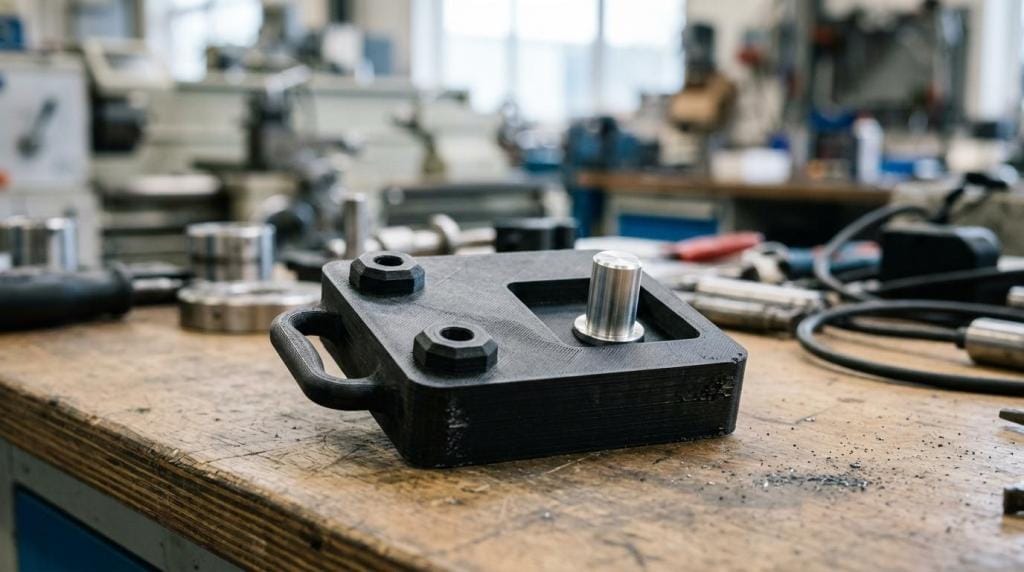
Production teams rely on jigs and fixtures when repeatability, speed and operator confidence matter. A well-made tool can cut setup time, reduce handling errors and help maintain stable output across assembly, inspection, machining support and maintenance tasks.
PartMade3D supplies industrial 3D printing and custom manufacturing services for businesses that need practical tooling without the long delays often tied to conventional methods. For Australian manufacturers and engineering teams, that means a faster path from CAD to a working tool, backed by engineering resources, technical material guidance and rapid quoting when timing is tight.
Custom jig and fixture manufacturing for industrial production
Jigs and fixtures are often grouped together, though they solve slightly different problems. A jig guides a tool or process. A fixture holds, locates or supports a part in the right position. In both cases, the goal is the same: produce a stable, repeatable workflow that helps operators do the job correctly every time.
Industrial additive manufacturing is well suited to this work. It allows complex forms, integrated locating features, lightweight structures, cable paths, ergonomic grips and fast revisions without the cost and lead time of traditional tooling on every job. That is especially useful when products change regularly, line layouts shift, or maintenance teams need a replacement tool in days rather than weeks.
PartMade3D supports end-to-end development for custom tooling, from prototype concepts through to production-ready parts. This includes rapid prototyping, replacement parts, refurbishment support and custom manufacturing for sectors including automotive, aerospace, defence, robotics, medical and mining.
After the first review of the application, common priorities usually become clear:
- Faster setup
- Repeatable part location
- Lower tool weight
- Better operator access
- Reduced rework
- Quicker tool replacement
3D printed jigs and fixtures for assembly, inspection and maintenance
Many tooling applications do not need heavy metal construction across the whole design. They need accuracy in the right places, durability for the duty cycle, and a geometry that suits the task. Additive manufacturing gives engineers more freedom to put material where it adds value and remove it where it does not.
That makes 3D printed tooling a strong option for assembly nests, drill guides, check fixtures, EOAT support hardware, alignment aids, maintenance templates and low-volume production tools. Features that would be awkward to machine can be built directly into the part, including datum references, labels, ergonomic handles, part protection surfaces and cable or fastener channels.
A practical tooling program often includes several categories of tools:
- Assembly fixtures: part positioning, holding, alignment and guided placement
- Inspection tools: repeatable checking for dimensions, fit, presence and orientation
- Maintenance aids: service guides, replacement templates and repair support tools
- Robotics tooling: EOAT brackets, sensor mounts, grippers and peripheral supports
Materials for jigs and fixtures in industrial environments
Material choice decides how a tool performs on the floor. A fixture used near heat, solvents or static-sensitive electronics needs different properties from a lightweight handling jig for internal assembly. This is where industrial-grade polymers become valuable, offering a strong balance of rigidity, weight, chemical resistance and production speed.
PartMade3D works with materials suited to real production conditions, including PA12-CF, ASA, TPU, ESD-safe options and heat-resistant polymers. The right selection depends on how the tool is loaded, cleaned, mounted and used over time.
| Material | Typical jig and fixture use | Key advantage |
|---|---|---|
| PA12-CF | Structural fixtures, robotic tooling, handling aids | High stiffness and low weight |
| ASA | Workshop tools, covers, outdoor-exposed tooling | UV and weather resistance |
| TPU | Soft contact surfaces, bumpers, grippers, protection pads | Flexibility and impact absorption |
| ESD-safe materials | Electronics assembly and inspection tooling | Static control |
| Heat-resistant polymers | Fixtures used near warm processes or heated parts | Better thermal stability |
Material choice should also reflect wear points, fastening strategy and operator interaction. A fixture body may need stiffness, while contact pads may need compliance to protect finished surfaces. Additive manufacturing supports multi-part tool designs that combine these needs without forcing the entire tool into a single material.
Jig and fixture design process for repeatable results
A strong jig or fixture starts with the application, not the part file alone. The best outcomes come from reviewing how the operator loads the part, what references matter, where tolerances stack up and how the tool will be mounted or moved. That early design work helps avoid tools that look good on screen but slow the job down in practice.
PartMade3D supports this process with engineering resources, CAD templates and technical data that help teams move from concept to release with fewer iterations. Rapid quoting also makes it easier to compare options when a team is balancing speed, strength and budget.
A typical project workflow can include:
- Application review: task, environment, cycle volume and operator needs
- Design refinement: locating strategy, ergonomic access, fastening and wear areas
- Material selection: stiffness, heat performance, ESD control or surface protection
- Manufacture and delivery: rapid production with local Australian support and international shipping
Some tools are built for a single production line. Others need modularity so they can adapt to product variants, service jobs or staged upgrades. That flexibility is one of the major strengths of additive manufacturing, where revisions can be made without restarting an expensive tooling program from scratch.
Benefits of additive manufacturing for production tooling
When manufacturers compare printed tooling with conventional tooling, the discussion usually starts with lead time and cost. Those are important, though the gains often go further. A lighter fixture can reduce operator fatigue. A better-designed assembly nest can reduce handling mistakes. A fast replacement path can keep a line moving when a tool is damaged.
This is why printed jigs and fixtures are now used well beyond early prototype environments. They are practical tools for production and maintenance when the application is designed around the real duty cycle and the right material set.
Teams often look for benefits like these:
- Shorter lead times for new tools and revisions
- Lower mass for manual handling and robot payload limits
- Integrated features that reduce secondary assembly
- Easier storage and transport
- Better fit for low-volume and high-mix manufacturing
The value becomes even clearer where products change regularly. Instead of holding onto outdated tooling because replacement is slow or costly, businesses can update tools as the product changes and keep the process current.
When 3D printed jigs and fixtures are the right choice
Not every tool should be printed, and that is an important part of good engineering judgement. If a fixture faces very high loads, harsh cutting forces or extreme wear, another process may be more suitable for some or all of the assembly. Yet many industrial applications sit well within the range of advanced polymer tooling.
3D printed jigs and fixtures are often the right choice when speed matters, geometry is complex, weight reduction is valuable, or the production volume does not justify heavy conventional tooling investment. They also make sense when procurement teams need a practical route for spare tools and replacement parts.
For Australian businesses, local support matters here. PartMade3D offers service coverage across Brisbane, Sydney, Melbourne, Perth, Adelaide, Darwin, Tasmania, the Sunshine Coast, Cairns and the Gold Coast, with international shipping to New Zealand, Canada, the USA, the UK and Europe. That gives engineering, procurement and maintenance teams a responsive path for both planned tooling and urgent replacements.
Jig and fixture support for Australian engineering teams
Fast tooling decisions depend on access to technical guidance, not just a machine. Engineers need data on materials, design limits and expected use cases. Procurement teams need a clear quote and reliable delivery. Maintenance teams need a fast answer when a broken tool affects uptime.
That combination of industrial materials, emergency quoting, engineering resources and industry-specific experience is what makes custom tooling workable at scale. Whether the need is a lightweight assembly aid, a robot support bracket, an inspection fixture or a replacement tool for a remote site, the goal stays the same: get a functional, repeatable solution into service quickly and with confidence.