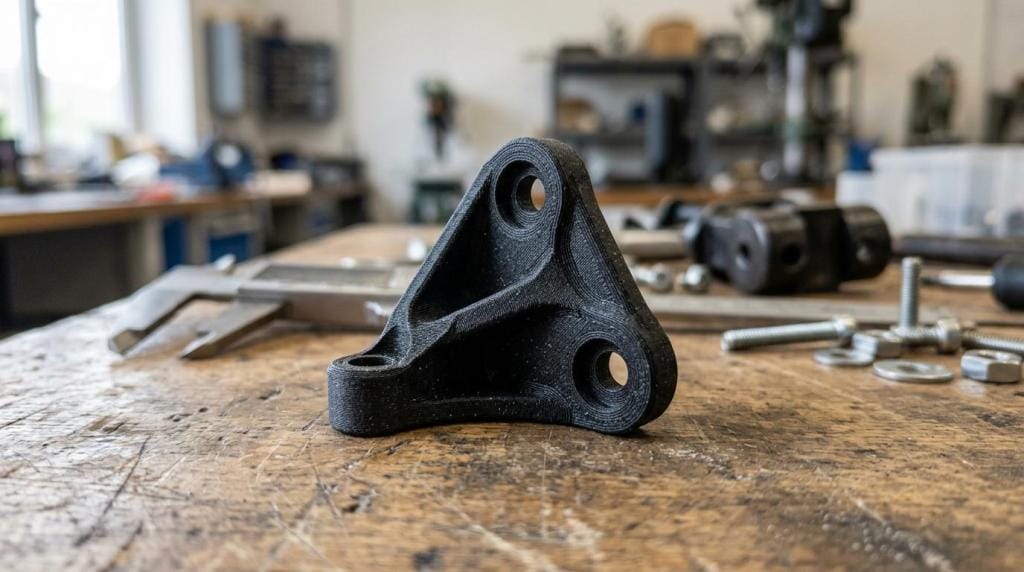
A functional prototype earns its place when a team needs proof, not just promise. It is the point where CAD gives way to something physical that can be handled, assembled, loaded, heated, flexed, tested and challenged in conditions that look much closer to real use.
That timing matters. Build one too early and you may spend money validating ideas that are still changing by the hour. Build one too late and design faults can spill into tooling, procurement, production planning or field performance. The strongest results usually come when a concept is clear enough to test properly, yet still flexible enough to improve quickly.
Functional prototyping in the product development cycle
Functional prototyping sits between early concept work and full production commitment. At the sketch or rough CAD stage, teams usually need speed and freedom. They are asking broad questions about architecture, packaging and feasibility. Once those answers start to settle, the questions become sharper: Will the latch survive repeated use? Can the housing hold tolerances around the connector? Does the bracket carry the load without creep or deformation?
That is where functional prototyping starts to pay off.
Instead of treating a prototype as a visual stand-in, a functional prototype is built to test behaviour. It helps engineers validate performance before they invest in tooling, long lead-time supply arrangements or production-grade fixtures. In many programs, this is the fastest way to expose the issues that CAD alone tends to hide.
A simple way to think about the timing is to match the prototype to the decision in front of you.
| Product stage | Main question | Best prototype focus |
|---|---|---|
| Early concept | Is this idea worth developing? | Low-cost concept model |
| Concept validation | Can the design work physically? | Functional prototype |
| Design iteration | What must change before release? | Repeated functional prototypes |
| Pre-production | Is the design ready for manufacture and use? | High-fidelity functional prototype |
| Production optimisation | How do we reduce unit cost or improve yield? | Process trials, pilot parts |
Key signs that functional prototyping should start now
Many teams wait for a formal stage gate before commissioning a functional prototype. In practice, the better trigger is technical uncertainty. If a design decision could create expensive rework later, it deserves a physical test sooner rather than later.
This is especially true when product performance depends on interactions that are difficult to simulate with confidence. A part may look excellent on screen and still fail at the interface between geometry, material and use conditions.
After that point, several signals usually justify moving into functional prototyping:
- Fit and assembly
- Motion and mechanism behaviour
- Thermal exposure
- Repeated loading
- User interaction
- Service access
There are also commercial signals. When tooling is expensive, timelines are compressed, or a maintenance team needs a replacement part quickly, the cost of not testing often rises well above the cost of a few controlled prototype iterations.
- Use it early when: the design includes hinges, clips, seals, threads, fastening points or moving interfaces.
- Use it before tooling when: moulds, dies or dedicated fixtures would lock in cost before the design is stable.
- Use it before procurement release when: suppliers need confirmed geometry, tolerances or assembly logic.
- Use it during maintenance planning when: a replacement component must match fit and function in an existing asset.
Why functional prototypes matter more for complex products
Not every product needs the same level of prototype rigour. A simple visual housing may only need a form model until late in development. A bracket inside a high-vibration machine, by contrast, may need physical testing very early because small design changes can alter stiffness, fatigue behaviour and mounting accuracy.
Complexity increases the value of functional prototyping because complexity multiplies interaction effects. The more a design relies on contact surfaces, load paths, tolerances, heat, fluids, cables, electronics or operator handling, the more likely it is that real-world performance will differ from initial assumptions.
In Australian manufacturing and asset-heavy sectors, this shows up clearly in:
- automotive components and fixtures
- aerospace support hardware
- robotics end-of-arm tooling
- industrial enclosures
- medical device housings and guides
- mining replacement parts
A functional prototype also brings clarity to cross-functional teams. Engineering may be focused on stress and geometry. Procurement may be focused on lead times and supplier options. Maintenance may care most about accessibility and service life. A physical part gives each group a shared reference point, which tends to shorten discussion and sharpen decision-making.
What a functional prototype should be testing
A useful functional prototype is not simply “more realistic” than a concept model. It is designed around a specific test objective. That objective should be defined before the part is built, otherwise teams often end up with an expensive sample that answers vague questions and leaves the critical ones unresolved.
The best programs choose two or three priority risks and test those directly.
That can include structural performance, assembly logic, ergonomic use, thermal resistance, sealing, vibration response or electrical packaging. In many cases, one prototype is not enough. A team might print one part to validate fit and another with adjusted wall thickness or fibre reinforcement to test load performance.
After a clear test plan is set, the prototype can be aimed at practical questions like these:
- Form and fit: does the part sit correctly within the assembly envelope, clear adjacent components and align with mating features?
- Function under load: does it hold shape and performance under expected force, torque, pressure or vibration?
- Thermal behaviour: does it remain stable near motors, electronics, sunlight, hot fluids or plant equipment?
- Assembly and serviceability: can technicians install, remove or replace it without awkward tools or excessive disassembly?
- User interaction: does the grip, reach, actuation force or tactile feedback suit the real task?
This focus is one reason industrial additive manufacturing is so valuable. It allows teams to build targeted prototypes quickly, revise geometry, change materials and test again without waiting on hard tooling.
Choosing functional prototyping materials for realistic testing
Material selection can make or break a functional prototype. If the chosen material is too soft, too brittle, too heat-sensitive or too different from the expected production part, the test may send the team in the wrong direction.
That does not mean the prototype must always match the final production material exactly. It means the material has to be appropriate for the risk being tested.
If the goal is a quick check of assembly and packaging, a lower-cost polymer may be fine. If the goal is repeated impact, outdoor exposure or antistatic performance, the material choice needs much more care.
At PartMade3D, this is where industrial-grade polymer options become useful across different applications. Materials like PA12-CF, ASA, TPU, ESD-safe grades and heat-resistant polymers support more realistic testing for production parts, tooling and prototypes in sectors where performance matters.
A practical material view looks like this:
| Testing priority | Useful material direction | Typical reason |
|---|---|---|
| Stiffness and structural response | Carbon-fibre reinforced nylon | Higher rigidity, lighter weight |
| Outdoor exposure | ASA | UV and weather resistance |
| Flex and impact | TPU | Elastic behaviour and durability |
| Static-sensitive environments | ESD-safe polymers | Protection around electronics |
| Heat exposure | Heat-resistant polymers | Better dimensional stability at temperature |
Even with a strong material match, a prototype still has limits. Layer-based manufacturing can produce direction-dependent properties, and surface finish or tolerances may need post-processing for critical interfaces. Good prototyping practice accounts for those realities instead of ignoring them.
Functional prototyping before tooling and production release
One of the clearest answers to the timing question is this: use functional prototyping before any step that becomes expensive to reverse.
That includes injection mould tooling, long-run machining strategies, supplier release, validation planning and stocking decisions for spare parts. The closer a business moves toward locked-in cost, the more valuable each early physical test becomes.
This is where functional prototyping shifts from a design tool to a business tool. It reduces the chance of paying for the wrong decision at full scale. For procurement teams, that can mean fewer changes after quote approval. For manufacturers, it can mean fewer surprises on the floor. For maintenance teams, it can mean confirming that a replacement part actually fits the asset before downtime stretches out.
In lower-volume environments, the prototype may also become a bridge part. That is common when demand is uncertain, equipment is ageing, or a replacement component is no longer available through the original supply chain. Instead of waiting for a conventional production method to be justified, teams can test a functional part, refine it, then move straight into small-batch supply if the application supports it.
Functional prototyping for Australian engineering teams under time pressure
Speed matters, but speed without intent can create noise. The strongest functional prototyping programs are fast because they are disciplined. They define the question, choose the right material, build only what needs to be tested, then feed results straight back into design.
That rhythm suits engineers and manufacturers who need practical answers quickly, whether they are in Brisbane, Sydney, Melbourne, Perth, Adelaide, Darwin, Tasmania or regional operations supporting mining, agriculture and field service.
A well-run workflow often looks like this:
- Identify the highest-risk design assumption.
- Build a prototype around that risk.
- Test it in realistic conditions.
- Update geometry, material or assembly logic.
- Repeat only until the key uncertainty is closed.
For businesses using industrial 3D printing services, the real gain is not just shorter lead time. It is better decision quality inside a shorter lead time.
That is why functional prototyping tends to create momentum across engineering, manufacturing and procurement at the same time. It helps teams move from “we think this will work” to “we have tested it, refined it and are ready for the next commitment”.
Where functional prototyping delivers the strongest return
The return is highest when the cost of error is high and the cost of iteration is manageable. That balance appears again and again in industrial settings.
It is visible in robotics tooling where grams matter, in automotive programs where fit and cycle time shape the business case, in aerospace support parts where geometry is demanding, and in maintenance work where the wrong replacement part can keep an asset offline.
Functional prototyping is also valuable when volumes are unclear. If a business is launching a niche product, trialling a custom fixture or replacing a legacy part with uncertain future demand, additive manufacturing can support validation without forcing a large upfront commitment.
For teams weighing whether the time is right, the practical question is simple: are you still guessing about real-world performance, while decisions around cost or release are getting harder to change?
If the answer is yes, functional prototyping is probably no longer optional. It is the next sensible step.