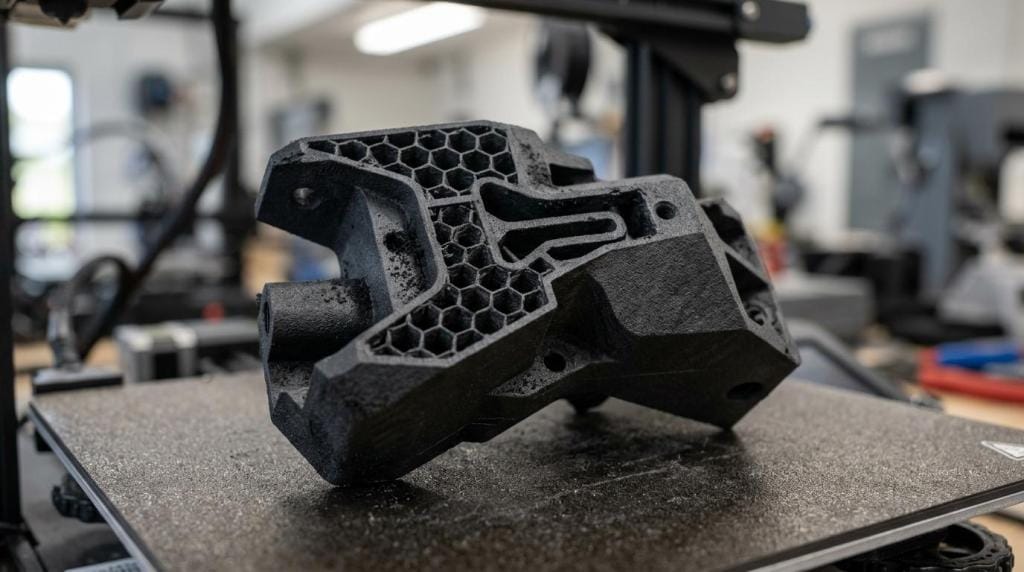
Production problems rarely announce themselves as a single crisis. More often, they show up as creeping lead times, repeat expediting, quality drift, and rising pressure on a team that is already full.
TL;DR: Summary
- Contract manufacturing makes the most sense when internal production is slowing growth, stretching lead times, or increasing supply-chain risk. It is usually a practical answer to capacity constraints, delivery reliability issues, and quality control gaps rather than a simple labour-cost decision.
- NIST says more than half of a manufacturer’s total spending occurs in the supply chain on average, which means outsourcing decisions should include materials, freight, expediting, downtime, and stockout risk, not just machine-hour rates.
- If customer dates are slipping, overtime is rising, or one machine cell or supplier has become a single point of failure, contract manufacturing can add capacity faster than building a new internal line.
- Onshoring often improves delivery reliability, quality control, and operational resilience. SBA guidance explicitly frames domestic sourcing as a way to reduce exposure to overseas disruptions and shorten lead times.
- The best contract manufacturing partners are judged on process fit, inspection discipline, traceability, responsiveness, and change control. A low unit price is not enough if the supplier cannot protect quality or recover under schedule pressure.
- Additive manufacturing is especially useful for bridge production, tooling, spares, and complex low-to-medium volume parts where hard tooling would lock up too much capital too early.
The real question is not whether outsourcing is “good” or “bad”. It is whether contract manufacturing solves a bottleneck more effectively than adding internal equipment, labour, and supplier complexity.
When does contract manufacturing make business sense?
Yes. Contract manufacturing makes sense when internal capacity is expensive to add and customer dates keep slipping. NIST notes that more than half of a manufacturer’s spending sits in the supply chain on average, so the decision is rarely just about machine hours.
A good trigger is when production demand has moved beyond a temporary spike and become a repeat pattern. If the same part families keep causing overtime, queue growth, or stockouts, external production is no longer a stopgap. It becomes a capacity strategy.
The SBA has also framed outsourcing as a way to access professional capability without significantly growing a full-time team. That matters when the alternative is buying equipment, hiring operators, qualifying new processes, and carrying those fixed costs even when demand softens.
“PartMade3D supports production parts, tooling and prototypes, which suits teams testing contract manufacturing before committing to permanent internal capacity.”
A common misconception is that contract manufacturing is only for startups or firms with no factory base. In practice, many established manufacturers outsource selected SKUs, overflow work, or specialist processes to protect margins and service levels.
Is lead-time pressure the clearest sign you need contract manufacturing?
Usually, yes. If ERP dates move more often than routing times, lead-time pressure is a strong outsourcing signal. NIST links delayed materials to work stoppages and missed shipments, which is why queue time often matters more than pure cycle time.
When quoted lead times drift from six days to three weeks, the issue is often not one slow machine. It is the full system: purchasing delays, setup bottlenecks, inspection backlogs, and rescheduling. Contract manufacturing can remove pressure from the busiest cells and restore more predictable delivery.
NIST’s supply-chain guidance is clear on the effect of delayed materials. Schedules slip, work stops, and customer shipments are missed. If that pattern is becoming normal, outsourcing selected parts can protect the rest of the plant from constant firefighting.
Common misconception: buying another machine always fixes the lead-time problem. If programming, fixturing, QA approval, or material availability are the true constraints, internal expansion can simply create a more expensive queue.
What are the 7 signs you need contract manufacturing?
Seven signs show up early in ERP data, customer complaints, and overtime costs. OEMs and MRO teams usually spot them before finance does, because the first symptoms are expediting, stockouts, and quote refusals rather than a single obvious failure.
The strongest signals are operational, not theoretical. If several of these are true at once, contract manufacturing is probably worth formal evaluation rather than another quarter of workarounds.
- You keep sending urgent prototypes, tooling, or spare parts to external specialists such as PartMade3D, and the ad hoc spend is becoming routine production support.
- Your lead times are longer than your customers’ buying window, so orders are delayed, split, or lost.
- Overtime and expediting are rising, but on-time delivery is still falling.
- One machine, one supplier, or one operator has become a single point of failure.
- You need a specialist process or material, but the internal capex case is weak.
- Quality results vary by shift, site, or batch, which suggests the process is not stable enough for the current load.
- You need bridge production now, but full tooling or a new internal line would take too long to justify and install.
If your business recognises four or more of these signs, the decision is usually no longer about whether to outsource. It becomes about which parts, volumes, and processes should move first.
How does contract manufacturing compare with building in-house capacity?
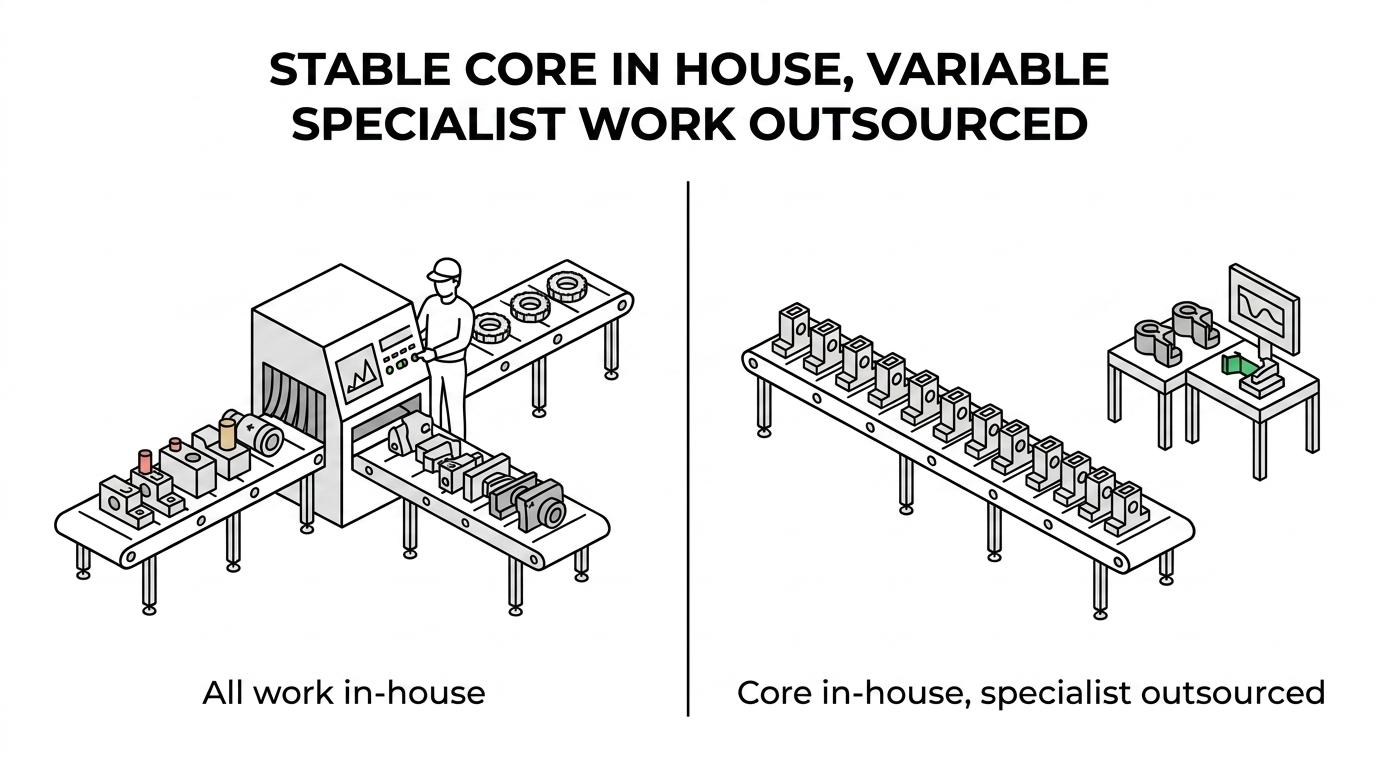
Neither model wins in every case. In-house production suits stable volume and tightly protected IP, while contract manufacturing suits variable demand and specialist processes. SBA guidance also notes outsourcing can add professional capability without expanding the full-time team.
Building capacity internally gives direct control over scheduling, work instructions, and process changes. That can be the right choice for high-volume parts with stable demand, sensitive know-how, or tightly integrated takt time requirements. Over enough volume, the unit economics may clearly favour in-house production.
Contract manufacturing is stronger when demand is uneven, the part mix changes often, or the process is not core to your advantage. In those cases, paying for available capacity is often safer than owning underused capacity.
“PartMade3D offers instant and emergency quoting, which is commercially useful when the real outsourcing problem is schedule recovery rather than headline unit price.”
Pro tip: compare breakeven against total loaded internal cost, not bare labour. Include programming, setup, scrap, inspections, maintenance, floor space, supervision, and the time needed to qualify a new line. Many internal business cases look stronger on paper than they do once those costs are counted.
Should you onshore or offshore contract manufacturing for better reliability?
Onshoring usually improves control, while offshore manufacturing may cut unit cost at scale. The SBA frames onshoring as a way to shorten lead times and strengthen quality control, and the U.S. Department of Commerce treats diversification as a competitiveness issue.
For Australian manufacturers, onshoring or nearshoring often means faster freight, easier communication, simpler first-article approvals, and fewer surprises with revisions. Those benefits matter most when parts are low-to-medium volume, operationally critical, or likely to change.
Offshore sourcing can still make sense where demand is stable, lead times are long but acceptable, and the order size is large enough to justify freight and inventory exposure. The trade-off is that the savings usually come with a longer cash cycle, larger minimum order quantities, and slower recovery when something goes wrong.
“PartMade3D serves teams across Brisbane, Sydney, Melbourne, Perth, Adelaide, Darwin, Tasmania and international markets, which helps when onshoring is driven by responsiveness and easier coordination.”
A practical rule works well here. If a late shipment can stop production, delay service work, or miss a customer programme milestone, reliability usually deserves more weight than the cheapest landed price.
How do you audit a contract manufacturer step by step?
Start with process fit, then quality, then response speed. ISO 9001 paperwork alone is not enough; you need evidence that the supplier can hold your tolerance, manage traceability, and recover when schedules tighten.
A disciplined audit should test real execution, not just credentials. Ask for sample parts, inspection records, material data, and examples of how non-conformances are handled.
- Step 1: Verify process fit: Confirm the supplier’s process, machine envelope, material set, and finishing options match the part’s geometry, tolerance stack, environment, and end use.
- Step 2: Check quality control: Review first-article inspection, in-process checks, traceability, calibration, document control, and how CAPA or NCR issues are closed.
- Step 3: Test responsiveness: Measure quote speed, engineering feedback quality, revision control, and how the team handles urgent changes or partial releases.
Pro tip: ask one difficult question early. A capable supplier will tell you where the design is risky, where tolerances are unrealistic, or where a material choice could fail in service.
How do you transfer a part to a contract manufacturer without delays?
A clean transfer starts with good data, not optimism. CAD files, drawings, BOMs, and inspection criteria must match, or the first article becomes a guessing exercise that adds days or weeks.
Step 1 is to define the manufacturing package. That includes the native CAD file where needed, the released drawing, revision level, material specification, finish, critical dimensions, acceptance criteria, and any assembly or packaging requirements. If the part is customer-facing or safety-relevant, add traceability and inspection expectations up front.
Step 2 is first-article approval. Run a pilot lot, inspect it against the drawing, and close any deviations before the supplier receives a recurring PO. If-then logic matters here: if the part will be used in a regulated or harsh environment, then insist on stronger documentation and a more formal approval gate.
Step 3 is replenishment and change control. Decide who owns forecast updates, buffer stock, revision notices, and concession approval. Common misconception: an STL file is enough for production. It may be enough for a visual model, but it is often not enough for controlled manufacturing where tolerances, datums, and material notes matter.
How do you calculate the true cost of contract manufacturing step by step?
True cost is wider than the quoted unit price. NIST says more than half of manufacturing spending sits in the supply chain on average, so freight, inventory, expediting, scrap, and downtime often change the real answer.
Start with direct costs, then add operating costs, then add risk. That order keeps the model honest and makes trade-offs easier to explain to finance and operations.
- Direct costs: unit price, tooling, setup, freight, packaging, and import or compliance charges where relevant
- Operating costs: incoming inspection, inventory holding, scheduling effort, expediting, and supplier management time
- Risk costs: scrap, warranty exposure, late-delivery penalties, line stoppages, and emergency buys from alternate sources
If a supplier reduces your average lead time and cuts expedite frequency, the savings may exceed a modest increase in unit price. By contrast, a low-cost source that forces larger buffers and more administration can quietly increase total cost.
A useful test is this: if the part fails to arrive on time, what does one day of disruption cost? In maintenance, mining, medical, aerospace, and robotics work, that number can dominate the entire sourcing decision.
When is additive contract manufacturing better than traditional production?
Additive contract manufacturing is strongest when speed, geometry, or tooling flexibility matter more than the lowest unit cost. PA12-CF and TPU are useful examples, because they let teams produce functional parts without committing to hard tooling too early.
This approach is especially effective for bridge production, end-of-arm tooling, jigs, fixtures, replacement parts, and low-volume end-use components. It also helps when a legacy part is obsolete, demand is intermittent, or a geometry would be expensive to machine or tool conventionally.
Part geometry is the simplest decision point. If a component benefits from internal channels, weight reduction, part consolidation, or rapid design changes, additive manufacturing often wins. If the part is a simple high-volume commodity with long demand visibility, traditional methods usually offer a lower per-unit cost.
“PartMade3D works with industrial-grade materials including PA12-CF, ASA, TPU, ESD-safe, and heat-resistant options, which matters when contract manufacturing is tied to real operating conditions rather than display models.”
A common mistake is to compare additive only against moulded unit price at full scale. The better comparison is total time, tooling commitment, revision flexibility, and inventory risk at the volume you actually need now.
What should you ask before signing a contract manufacturing agreement?
Ask about capacity, quality, change control, and commercial terms before you sign. A PO and an NDA are not a process plan, and that misconception causes many avoidable delays.
The best questions are operational. They reveal whether the supplier can hold service levels when the work becomes real, not just when the sample quote looks attractive.
- Capacity: What are the standard lead times, and what happens during surge demand or machine downtime?
- Quality: What inspections are included, and how are first articles, traceability, and non-conformances managed?
- Change control: How are drawing revisions, deviations, concessions, and rework approvals documented?
- Supply chain: Which materials are single-source, and what alternates are already qualified?
- Commercial terms: Who owns tooling, what are the minimum order quantities, and how are expedite fees or stock commitments handled?
One final check is worth making before release. If the supplier relationship depends on heroic follow-up from one buyer or one engineer, the process is not ready yet. A strong contract manufacturing setup should run on clear data, clear approvals, and repeatable service expectations.